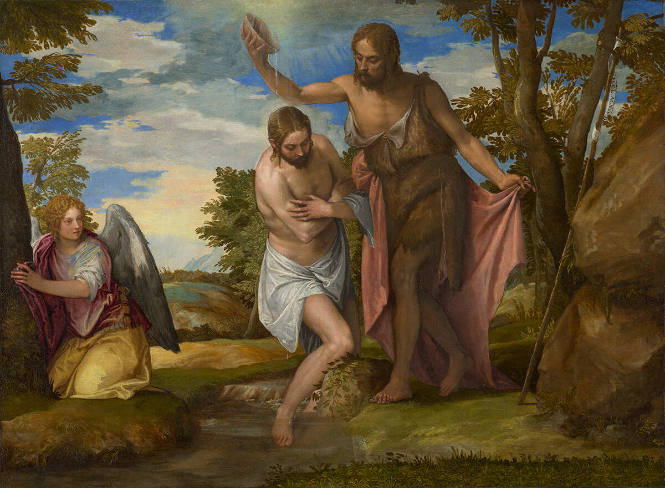
The Baptism of Christ
Artist
Paolo Veronese (Paolo Caliari)
b. 1528, Verona; d. 1588, Venice
Datecirca 1550–1560
MediumOil on canvas
Dimensions33 3/4 x 46 in. (85.7 x 116.8 cm)
Frame: 41 1/2 x 53 3/4 x 4 in. (105.4 x 136.5 x 10.2 cm)
Frame: 41 1/2 x 53 3/4 x 4 in. (105.4 x 136.5 x 10.2 cm)
ClassificationsPaintings
Credit LineGift of the Samuel H. Kress Foundation
Object numberGL.60.17.47
On View
On viewChrist’s baptism was a popular subject during the Renaissance because it allowed artists to display their prowess at landscape painting. Like many of his contemporaries, Veronese placed his figures in a landscape more typical of Italy than the Holy Land.
[L. Humphrey, “The People’s Collection, Reimagined,” 2023]
ProvenanceCreated in Venice ca. 1550–1560 [1]. Ferdinand Vandeneynden, 1st marquess of Castelnuovo (1584–July 3, 1674), Palazzo Zevallos Stigliano, Naples, by July 3, 1674 [2]; by inheritance to his widow Olinda Piccolomini Vandeneynden (d. 1708), 1678–1688 [2 bis]; by inheritance to Giovanna Vandeneynden (1676–1716), Palazzo Zevallos Stigliano, Naples, by December 29, 1688 [3]; presumably, by descent to Giuliano Colonna di Stigliano (1671–1732), 1st prince of Sonnino and prince of Galatro; by descent to Ferdinando Colonna di Stigliano (1695–1775), 2nd prince of Sonnino; by descent to Marcantonio Colonna di Stigliano, 3rd prince of Sonnino (1724–1796); dispersed after June 13, 1799 [4]. Acquired by William à Court (1779–1860; later 1st Baron Heytesbury) in Naples between 1801 and 1807 and later sent to Heytesbury House, Wiltshire [5]; by descent to William Henry Ashe Holmes à Court (1809–1891), 2nd Baron Heytesbury, Heytesbury House [6]; by inheritance to his grandson, William Frederick Holmes à Court (1862–1903), 3rd Baron Heytesbury, Heytesbury House; by descent to his widow, Margaret Anna Harman (d. January 7, 1920), the Baroness Heytesbury, Heytesbury House; her estate, 1920–1926; [Heytesbury House sale, Hampton & Sons in conjunction with Messrs. Edens, Heytesbury, Wiltshire, April 26–30, 1926 (day 4), cat. no. 1322, as Lucini, The Baptism] [7]; [P. & D. Colnaghi, London in joint account with M. Knoedler and Sons, stock no. A 1536] [8]; sold May 7, 1926 to H. M. Clark, London [9]. [Alessandro Contini-Bonacossi (1878–1955), Rome-Florence, by 1935]; sold to Samuel H. Kress (1863–1955), inv. K388, October 10, 1935; given to the National Gallery of Art, June 29, 1939; deaccessioned and returned to the Samuel H. Kress Foundation, April 30, 1959; given to North Carolina Museum of Art, December 9, 1961.
[1] Rearick 1988, 73–74, 84, argues that the size and format of the painting indicates it was made for private chapel or sacristy; Ilchman 2012, 178: “Judging by format and scale, the Raleigh Baptism was probably intended to be a work of private devotion—perhaps for a patron named Giovanni Battista—and it might have originally been displayed in a private home in Venice, perhaps in the main hall on a palazzo’s piano nobile, in a room known as a portego.”
[2] A later owner, William à Court, stated in his 1843 catalogue that The Baptism by Veronese came from the “Stigliano Palace at Naples.” Through verbal tradition, this information was passed down and was ultimately recorded without source attribution in Fern Rusk Shapley’s 1960 catalog entry, 60. That the painting was once hanging in the Palazzo Zevallos Stigliano in Naples is affirmed by the painting’s appearance in the 1688 inventory of the palace and its contents, the paintings of which were described and appraised by the painter Luca Giordano. Giordano put the inventory together in 1688, after the three daughters inherited Ferdinando’s estate from their mother, Olinda Piccolomini Vandeneynden. When Ferdinando died in 1678, Olinda became the guardian of his inheritance for ten years, at which point the daughters filed applications to take possession of their inheritance. See the following note. See also Steel 1994, 78n1 for the minor discrepancies between the inventory description and the actual painting.
Regarding the spelling of the family’s surname as one word, rather than as Van den Eynden, this is the most common spelling in documentary and bibliographical sources in the Neapolitan area.
[3] On December 29, 1688, the Vandeneynden estate was split between her three daughters (as recorded in three deeds drawn up by notary Francesco Nicola Dell’Anversana on that day; now Archivio di Stato di Napoli, Notai del XVII secolo, notaio Francesco Nicola Dell’Anversana, scheda 482, protocollo 28, cc. 621v–667r). The second part of Luca Giordano’s above-mentioned 1688 inventory of the estate–corresponding to Giovanna Vandeneynden’s portion of the inheritance–was later published in Colonna 1895, 29–32 (on this see Ruotolo 1982, 12). The complete inventory is transcribed in Denunzio 2018, 149–201. See 185 for “the Baptism of Saint John the Baptist and angels, by the hand of Paolo Veronese”.
[4] According to Colonna 1895, 30, the collection in the Palazzo Zevallos Stigliano was dispersed after the June 13, 1799 attack on Naples by the Armata della Santa Fede in a populist revolt led by Cardinal Ruffo.
[5] The painting is recorded in William à Court’s collection as early as 1828, when loaned to the exhibition of the British Institution. À Court (created Baron Heytesbury in 1828), began collecting art during his first diplomatic appointment in Naples, as Secretary of Legation from 1801 to 1807; on his diplomatic posts, see R. G. Thorne, “À Court, William (1779–1860) of Heytesbury, Wiltshire,” in The History of Parliament: House of Commons 1790–1820, ed. R. G. Thorne (London: Boydell and Brewer, 1986).
As noted above, a Baptism by Veronese is listed in William à Court’s 1843 inventory of the 76 works then hanging at Heytesbury House, 1–2, no. 1. It was depicted as in the drawing room, with a diagram showing the arrangement of pictures 1–8 on the east wall. According to the inventory, 10n34, à Court also acquired Guercino’s Mary Magdalene from the Stigliano palace (sold at the 1926 Heytesbury House sale as lot 1311, Guercino, The Magdalen, 50 in. x 40 in.).
[6] When William Henry Ashe à Court married Elizabeth Holmes, daughter of Sir Leonard Worsley-Holmes, 9th Baronet, in 1833, he assumed, by royal license, the additional surname of Holmes; see The London Gazette, 18 October 1833, 1869, No. 19094. In 1860, William Henry Ashe changed the family name, again by royal license, from à Court-Holmes to Holmes-à Court; see The London Gazette, 21 August 1860, 3087, no. 22415. See the biographical summary in http://harfordenterprisescomau.melbourneitwebsites.com/persistent/catalogue_files/products/acourtfamilyheytesburyestate.pdf.
[7] The sale was organized by order of the executors of the estate of Margaret Anna Harman, the Baroness Heytesbury, widow of the 3rd Baron Heytesbury.
[8] According to the Colnaghi stock books (A 1536), as reported to David Steel in a letter of November 2, 1992 from Maria L. Gilbert, provenance archivist, The Getty Art History Information Program. The painting does not appear in Knoedler stock books or commission books.
[9] Reported to William J. Chiego, NCMA, in a letter of July 31, 1987 from Martha Hepworth, assistant provenance archivist, The Getty Art History Information Program, citing microfiche copy of Colnaghi’s stock books. Van Hadeln 1926, 104 published the painting as in the HM Clark collection.Published ReferencesLuca Giordano, comp., manuscript inventory of the Galleria del Principe di Galatro Don Giuliano Colonna, 17 November 1688, in Ferdinando Colonna di Stigliano, “Inventario dei quadri di Casa Colonna fatto da Luca Giordano,” Napoli nobilissima: Rivista di Topografia ed Arte Napoletana 4, no. 1 (1895), 29–32 at 31, no. 44 (as depicting the baptism of St. John the Baptist, and angels, by Paolo Veronese).
British Institution for Promoting the Fine Arts in the United Kingdom, Catalogue of Pictures by Italian, Spanish, Flemish, Dutch, and English masters wIth which the proprietors have favored the institution (exhibition catalogue) (London: William Nicol, June 1828), cat. no. 157, 18 (as St. John Baptizing Our Savior by P. Veronese, from Lord Heytesbury, G.C.B.).
William à Court, “Catalogue of Pictures at Heytesbury House, 1843,” no. 1, preface (list of original costs of Lord Heytesbury’s paintings), no. 1, 2 (as The Baptism by Paul Veronese, kept in the East End of the Drawing Room, originally from the Stigliano Palace at Naples).
G. F. Waagen, Galleries and Cabinets of Art in Great Britain (London: John Murray, 1857), 386 (as The Baptism of Christ by Paul Veronese).
British Institution for Promoting the Fine Arts in the United Kingdom, Catalogue of pictures by Italian, Spanish, Flemish, Dutch, and English masters wIth which the proprietors have favored the institution (exhibition catalogue) (London: J. B. Nichols and Sons, June 1866), cat. no. 54, 9 (as St. John Baptizing The Savior by P. Veronese, from Lord Heytesbury).
Algernon Graves, A Century of Loan Exhibitions 1813–1912, vol. 4 (Algernon Graves: London, 1913–1915), 1575–76 (as in Lord Heytesbury collection).
Detlev Baron von Hadeln, “Two Paintings of the Baptism by Paul Veronese,” Apollo 4 (1926), 104–106, illus. (b-w) 106 (as in H.M. Clark collection).
“Heytesbury House,” Heytesbury, Wiltshire. Catalogue of the Contents of the Mansion (auction catalogue) (London and Heytesbury: Hampton & Sons in conjunction with Messrs. Edens, April 27–May 1, 1926), lot 1322, 91, as Lucini, The Baptism.
Percy H. Osmond, Paolo Veronese: His Career and Work (London: The Sheldon Press, 1927), 56, 112 (as in the collection of H.M. Clark, who acquired it from Lord Heytesbury).
Giuseppe Fiocco, Paolo Veronese (Rome: Casa Editrice d’Arte “Valori Plastici”, 1934), 122.
Walter Heil, Exhibition of Venetian Painting From the Fifteenth Century through the Eighteenth Century (exhibition catalogue) (San Francisco: Palace of the Legion of Honor, 1938), cat. no. 74.
Religious Art: An Exhibition of Fourteenth-, Fifteenth-, Sixteenth- and Seventeenth-Century Paintings, Sculpture, Illuminated Manuscripts, Metalwork, Rosaries, Textiles, Stained Glass and Prints (exhibition catalogue) (Baltimore: Baltimore Museum of Art, 1938), cat. no. 37.
Masterworks of Five Centuries: Official Catalog: Department of Fine Arts, Division of European Art, Golden Gate International Exposition, San Francisco 1939 (exhibition catalogue)(San Francisco: Schwabacher-Frey Co. and H.S. Crocker Co., Inc., 1939), cat. no. 58.
Alfred M. Frankfurter, “Dayton: European Loans from Kress Collections,” The Art News (December 23, 1939), 13.
Walter Pach, Catalogue of European and American Paintings 1500–1900s: Masterpieces of Art, New York’s World Fair, May to October, 1940 (exhibition catalogue)(New York: Art Aid Corporation, 1940), cat. no. 22, 20.
National Gallery of Art: Preliminary Catalogue of Paintings and Sculpture (Washington, DC: National Gallery of Art., 1941), cat. no. 323, 210.
Alfred M. Frankfurter, “The Kress Collection in the National Gallery,” Art News 43, no. 16 (December 1, 1944), no. 62, 25–84 at 70, 160–174 at 170.
Bernard Berenson, Italian Pictures of the Renaissance: Venetian School, vol. 1 (London: The Phaidon Press, 1957), 139.
Fern Rusk Shapley with W. R. Valentiner, The Samuel H. Kress Collection (Raleigh: North Carolina Museum of Art, 1960), 96, illus. (color) 97.
The Italian Heritage: An Exhibition of Works of Art Lent from American Collections for the Benefit of the Committee to Rescue Italian Art (exhibition catalogue) (New York: Wildenstein, 1967), cat. no. 29, illus. (b-w).
Remigio Marini, L’opera completa del Veronese (Milan: Rizzoli, 1968), cat. no. 5, 87.
Luciana Crosato Larcher, review of L’opera completa del Veronese, by Remigio Marini, Arte Veneta 22 (1968): 220–224.
Antonio Morassi, “Un ‘Battesimo’ inedito di Paolo Veronese,” Arte Veneta 22 (1968), 30–38 at 30, 36, fig. 47, 37.
Stephen W. Clayton and Edward F. Weeks, Veronese and His Studio in North American Collections (exhibition catalogue) (Birmingham:: Birmingham Museum of Art, 1972), 19, illus. (b-w).
Fern Rusk Shapley, Paintings from the Samuel H. Kress Collection: Italian Schools: XV–XVI Century (New York: The Phaidon Press, 1973), K388, 43, fig. 72 (as Studio of Paolo Veronese).
Terisio Pignatti, Veronese, vol. 1 (Venice: Alfieri, 1976), cat. no. 4, 15–16, 103–4, fig. 5.
Richard Cocke, review of Veronese, L’Opera Completa, by Terisio Pignatti, Burlington Magazine 119 (December 1977): 786–787.
George R. Goldner, “A Baptism of Christ by Veronese in the Getty Museum,” The J. Paul Getty Museum Journal 9 (1981), 111–126 at 114, fig. 4, 116.
Richard Cocke, Veronese’s Drawings: A Catalogue Raisonne (London: Sotheby Publications, 1984), 293–294, fig. 96 (as workshop of Veronese).
Rodolfo Pallucchini, Veronese (Milan: Mondadori, 1984), cat. no. 12, 4, 51, illus. (b-w) 165.
Gene Thornton, “A New Look at Two Old Masters at the National Gallery,” The News and Observer, December 18, 1988.
William R. Rearick with Terisio Pignatti, The Art of Paolo Veronese: 1528–1588 (exhibition catalogue) (Washington, DC: National Gallery of Art, 1988), cat. no. 39, 73–74, 84.
Richard Cocke, review of “Paolo Veronese,” Burlington Magazine 131, no. 1030 (January 1989), 61–64 at 62.
Terisio Pignatti and Filippo Pedrocco, Veronese: Catalogo completo dei dipinti (Firenze: Cantini, 1991), cat. no. 11, illus. (b-w) 31.
Nicholas H. J. Hall, ed., Colnaghi in America: A Survey to Commemorate the First Decade of Colnaghi New York (New York: Colnaghi, 1992), 132.
Introduction to the Collections, 2nd rev. ed. (Raleigh: North Carolina Museum of Art, 1992), illus. (b-w) 177.
Keith Christiansen in Jusepe de Ribera, 1591–1652 (exhibition catalogue), eds. Alfonso E. Pérez Sánchez and Nicola Spinosa (New York: Metropolitan Museum of Art, 1992), 151 (in cat. no. 61).
David Steel, “A Gift to America: Masterpieces of European Painting from the Samuel H. Kress Collection,” North Carolina Museum of Art Preview (Winter 1993), 8.
David Streel, “Paolo Caliari, called Veronese,” in Chiyo Ishikawa, et al, A Gift to America: Masterpieces of European Painting from the Samuel H. Kress Collection (exhibition catalogue) (New York: Harry N. Abrams, Inc., 1994), cat. no. 4, 75–79.
Chuck Twardy, “Store-Bought Art,” News and Observer (Raleigh, NC), February 6, 1994, 10G.
Terisio Pignatti and Filippo Pedrocco, Veronese, vol. 1 (Milan: Electa, 1995), cat. no. 14, 21, 47–49.
William R. Rearick, entry in Dal Pordenone a Palma il Giovane: Devozione e pietà nel disegno veneziano del Cinquecento (exhibition catalogue), ed. Caterina Furlan, with the collaboration of Vittoria Romani (Milan: Electa, 2000), cat no. 44, 170.
Richard Cocke, Paolo Veronese: Piety and Display in an Age of Religious Reform (Aldershot and Burlington: Ashgate Publishing, 2001), cat no. 45, 208 (discussed with Baptism in the Palazzo Pitti).
David Rosand, Véronèse (Paris: Citadelles & Mazenod, 2012), 206–207, fig. 175, 209 .
Virginia Brilliant, “Veronese in America: Collecting and Taste,” in Paolo Veronese: A Master and His Workshop in Renaissance Venice (exhibition catalogue), ed. Virginia Brilliant (London: Scala Publishers, for the John and Mable Ringling Museum of Art, 2012), 87–101 at 97.
Frederick Ilchman, “The Baptism of Christ,” in Paolo Veronese: A Master and His Workshop in Renaissance Venice (exhibition catalogue), ed. Virginia Brilliant (London: Scala Publishers, for the John and Mable Ringling Museum of Art, 2012), cat. no. 37, 175–183, 255–256 (notes), 262.
Antonio Ernesto Denunzio, ed., Rubens, Van Eyck, Ribera: La collezione di un principe (Milan: Silvana Editoriale, 2018), 149–201 at 185 (the Vandeneynden 1688 inventory, as The Baptism by Veronese).
David Rosand, Paolo Veronese, Mary E. Frank, ed. (London and Turnhout: Harvey Miller, 2023), 184, fig. 7.10.
Kress Collection Digital Archive, National Gallery of Art, accessed 6/30/26, https://kress.nga.gov/Detail/objects/3472.Exhibition HistoryLondon, British Institution for Promoting the Fine Arts in the United Kingdom, 1828, cat. no. 157.
London, British Institution for Promoting the Fine Arts in the United Kingdom, “Exhibition of the Works of Ancient Masters and Deceased British Artists,” June 1866, cat. no. 54.
San Francisco, California Palace of the Legion of Honor, “Exhibition of Venetian Painting from the Fifteenth Century through the Eighteenth Century,” June 25–July 24, 1938, cat. no. 74.
Seattle, Seattle Art Museum, “Venetian Paintings from the Samuel H. Kress Collection,” August 1–25, 1938; Portland, OR, Portland Art Museum, September 1–26, 1938; Montgomery, AL, Montgomery Museum of Fine arts, October 1–31, 1938 (no catalog).
Baltimore, Baltimore Museum of Art, “Religious Art: An Exhibition of Fourteenth-, Fifteenth-, Sixteenth- and Seventeenth-Century Paintings, Sculpture, Illuminated Manuscripts, Metalwork, Rosaries, Textiles, Stained Glass and Prints,” December 4, 1938–January 1, 1939, cat. no. 37.
San Francisco, Golden Gate International Exposition San Francisco 1939, “Masterworks of Five Centuries,” February 18, 1939–October 29, 1939, cat. no. 58; traveled to Dayton, OH for exhibition at the Dayton Art Institute, December 1, 1939–April 8, 1940.
New York, “Masterpieces of Art: New York World’s Fair 1940,” May–October, 1940, cat. no. 22.
New York, Wildenstein & Co., “The Italian Heritage: An Exhibition of Works of Art Lent from American Collections for the Benefit of the Committee to Rescue Italian Art,” May 17–September 3, 1967, cat. no. 29.
Birmingham, AL, Birmingham Museum of Art, “Veronese and His Studio: In North American Collections,” October 1–November 15, 1972; traveled to Montgomery, AL, Montgomery Museum of Fine Arts, December 5–December 31, 1972, 19.
Washington, DC, National Gallery of Art, “The Art of Paolo Veronese: 1528–1588,” November 13, 1988–February 20, 1989, cat. no. 39.
Raleigh, NC, Houston, Seattle, and San Francisco, “A Gift to America: Masterpieces of European Painting from the Samuel H. Kress Collection,” North Carolina Museum of Art (February 5–April 24, 1994); The Museum of Fine Arts Houston (May 22 –August 14, 1994); Seattle Art Museum (September 15–November 20, 1994); The Fine Arts Museums of San Francisco (December 17, 1994–March 4, 1995), cat. no. 4.
Sarasota, FL, John and Mable Ringling Museum of Art, “Paolo Veronese: A Master and His Workshop in Renaissance Venice,” December 7, 2012–April 14, 2013, cat. no. 37, illus. (color) 176.
Raleigh, NC, North Carolina Museum of Art, “Venice and the Ottoman Empire,” September 28, 2024–January 5, 2025 (not in catalog). Object Rights Statement
The North Carolina Museum of Art (NCMA) makes images of its collection available online to support research and scholarship and to inform and educate the public. Certain works of art, as well as the photographs of those works of art, may be protected by copyright, trademark, or related interests not owned by the NCMA. The responsibility for ascertaining whether any such rights exist and for obtaining all other necessary permissions remains with the applicant. To request images and/or permissions from the NCMA, please complete our online request form.

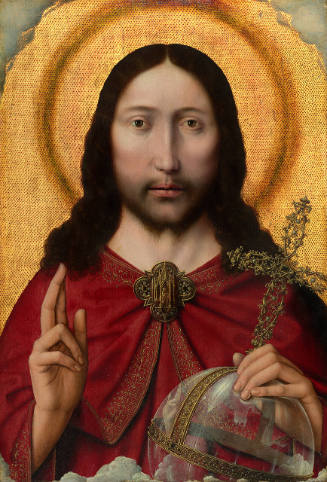
Quentin Massys [variously spelled Massys, Matsys, Metsijs]
circa 1500–1510