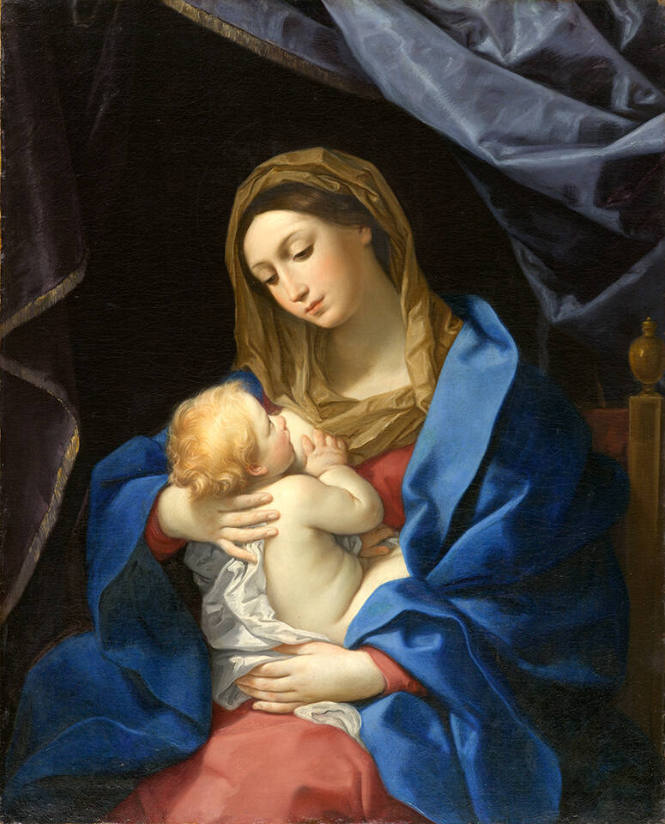
The Virgin Nursing the Christ Child
Artist
Guido Reni
Italian, 1575–1642
Datecirca 1628–1630
MediumOil on canvas
Dimensions45 x 36 in. (114.3 x 91.4 cm)
Frame: 61 7/8 x 53 3/8 in. (157.2 x 135.6 cm)
Frame: 61 7/8 x 53 3/8 in. (157.2 x 135.6 cm)
ClassificationsPaintings
Credit LineGift of Mr. and Mrs. Robert Lee Humber in memory of their daughter, Eileen Genevieve
Object numberG.55.12.1
On View
On viewThe original patron of this work is uncertain, but by 1657 it was hanging in the sacristy of the royal monastery of El Escorial, near Madrid, having been placed there by Philip IV, king of Spain, on the advice of painter Diego Velázquez.
[L. Humphrey, “The People’s Collection, Reimagined,” 2023]
ProvenancePossibly commissioned by Vittoria Colonna (1558–1633) [1], Rome, about 1628; her son, Juan Alfonso Enríquez de Cabrera y Colonna, Ninth Admiral of Castile, 5th Duke of Medina de Rioseco and the 8th Count of Melgar (1594–d. 1647) [2]; Philip IV, King of Spain (1605–1665; r. Spain 1621–1665), 1646–1657; Sacristy, Real Monasterio de San Lorenzo de El Escorial, Madrid, by 1657 [3]; seized by Napoleon Bonaparte’s French army during The Peninsular War (1808–1814), 1808 [4]; Joseph Bonaparte, King of Spain (1768–1844; r. 1808–1813); Horace-François-Bastien Sébastiani de La Porta (1771–1851) [5]; Vincenzo Camuccini (1771–1844) [6]; [Samuel Woodburn, London (1786–1853)] [7]; Robert Stayner Holford (1808–1892), London and Westonbirt, Gloucestershire, by 1839 [8]; his son, George Lindsay Holford (1860–d. 1926), Westonbirt, Gloucestershire [9]; [his estate sale, Christie, Manson & Woods, London, July 15, 1927, lot 69, as Benedetto Luti; Ramsay, from 1927 [10]. [Christie, Manson, & Woods, London, December 18, 1953, lot 87; Thule, from 1953 [11]; [Christie, Manson, & Woods, London, March 5, 1954, lot 54 ; [Adolfo Werner, Milan, from 1954] [12]; [David Koetser, New York, by October 1954] [13]; acquired by the NCMA in 1955 with funds provided by Mr. and Mrs. Robert Lee Humber.
[1] Regarding Vittoria Colonna ownership, this was presumed, probably correctly, by David Steel based on Nicklas 1980’s assertion that the next owner was her son Juan Alfonso Enríquez de Cabrera y Colonna, which is based on Nicklas’s knowledge of the painting’s later presence in the Sacristy of El Escorial. According to Pepper 1984, 259, cat. no. 119, pl. 148 the painting was said to come from the Barberini collection, although no trace of such picture exists in the Barberini documents or inventories. Reni lived in Rome 1601–1614, and back to Bologna in 1614.
[2] Nicklas 1980, 10, writes: “Serodine’s Saint Margaret, fig. 15, and perhaps Reni’s Virgin nursing the Christ Child, fig. 7, were presented by the Admiral of Castile, who served as ‘obedienza’ ambassador in 1648.” On 14n48 she cites Ludwig Freiherr von Pastor, The History of the Popes, 30, St. Louis, 1938, 58 and the inventory of the Admiral of Castile’s collection in Fernandez-Duro 1902, no. 125, 193—an inventory of Cabrera’s collection (‘Una Ntra. Sra., con el niño, en lámina, con marco ahovado y dorado, de mano del Guido, 2000 reales’). Juan Alfonso Enríquez de Cabrera y Colonna was the son of Luis Enríquez de Cabrera who died young in Valladolid in 1600, VIII Admiral of Castile, and Vittoria Colonna (1558–1633), who was the daughter of the great Constable of Naples Marc Antonio II (Duke Paliano Tagliacozzo) Colonna (1535–585) and Felice Orsini (1535–1596). See also Nicklas 1980, appendix no. 10.
[3] Nicklas 1980, appendix no. 10. The sacristy was decorated by Velazquez. Fire damaged the El Escorial monastery and destroyed some of its contents in 1671. In 1808, it was plundered by Napoleon Bonaparte’s French army and four years later was occupied by English and Portuguese troops as the French retreated. Since 1885, it has been occupied by the Order of St. Augustine, although it is now administered by Spain’s Patrimonio Nacional.
[4] Nicklas 1980 does not mention the date of the removal of Reni’s Virgin Nursing the Christ Child from the sacristy, but she dates the seizing of Raphael’s Holy Family (or La Perla) and other paintings as occurring in 1808.
[5] Nicklas 1980, appendix no. 10 citing Madrazo 1884, 299. In 1808–1811, during the Peninsular War, Horace Sébastiani was stationed in Spain as commander of the French army’s 1st Division of IV Corps. He was made Count of the Empire in recognition of his contributions.
[6] Pepper 1984, 259, cat. no. 119, without documentation. Camuccini was an academic painter of histories and religious paintings who lived in Rome. The source of this information is unknown.
[7] Pepper 1984, 259, cat. no. 119, without documentation.
[8] British Institution for Promoting the Fine Arts in the United Kingdom 1839, 9, cat. no. 49. It was loaned to the June 1839 exhibition of the British Institution for Promoting the Fine Arts in the United Kingdom as from R.S. Staynor, Esq. The painting is not mentioned in Waagen’s 1854 description of R.S. Holford’s gallery (vol. 2, 193–222), then located in the house Holford was renting on Russell Square (formerly occupied by Thomas Lawrence) during the construction of a mansion in Park Lane—Dorchester House.
[9] Benson 1924, 71. Location at Westonbirt is indicated by Robert Benson’s 1924 catalog of the Holford collection at Westonbirt.
[10] Christie, Manson, & Woods 1927, 26, cat. no. 69. Sale to Ramsay per annotated sale catalog (Levy Collection, NCMA).
[11] Christie, Manson, & Woods 1953, 14, cat. no. 87. Sale to Thule per annotated sale catalog in file.
[12] Christie, Manson, & Woods 1954, 10, cat. no. 74. Sale to Werner per annotated sale catalog in file.
[13] Exhibited in 1954 Guido Reni exhibition in Bologna as with David Koetser. Cf. Garboli 1971, 105, cat. no. 139.
Published ReferencesFrancisco de los Santos, Descripcion breve del Monasterio de S. Lorenzo el Real del Escorial, Descripción breve del Monasterio de S. Lorenzo el Real del Escorial: Unica maravilla del mundo: Fabrica del prudentisimo rey Philipo Segundo (Madrid: Imprenta Real, 1657), fol. 46v (“En el ultimo lugar està una imagen de Nuestra Señora con el Niño al pecho, de Guido Boloñés. Todas estas nueve Pinturas, que corren sobre la Cornija, se reducen a un mismo tamaño, que es de cinco pies de altro, y tres, y tres quartos de ancho.”)
Francisco de los Santos, Descripcion breve del Monasterio de S. Lorenzo el Real del Escorial: unica maravilla del mundo: Fabrica del prudentisimo rey Filipo Segundo, nuevamente coronada por el catolico rey Filipo quarto el Grande con la Magestuosa obra de la Capilla (Madrid: Joseph Fernandez Buendia, 1667), fol. 49r (“En el ultimo lugar esta una imagen de Nuestra Señora con el Niño al pecho, de Guido Boloñés. Todas estas nueve Pinturas, que corren sobre la Cornixa, se reducen a un mismo tamaño, que es de cinco pies de altro, y tres, y tres quartos de ancho.”)
Catalogue of Pictures by Italian, Spanish, Flemish, Dutch, and French Masters: With Which the Proprietors have Favoured the Institution (exhibition catalogue) (London: British Institution, 1839), 9 cat. no. 49, (as Virgin and Child by Guido from the collection of R. S. Holford, Esq.; cited in Nicklas 1980, appendix no. 10. Note that Pepper 1984, 259, cat. 119, believed our painting was also included in the 1848 exhibition as cat. 3, a “Holy Family” by Guido, but R. S. Holford also owned a small copper by Reni depicting the Holy Family with St. John, a painting exhibited 1887, no. 116).
Pedro de Madrazo, Viaje artístico de tres siglos por las colecciones de cuadros de los reyes de España (Barcelona: Biblioteca Arte y Letras, 1884), 299.
Cesareo Fernandez Duro, El Ultimo Almirante de Castilla: Don Juan Tornas Enriquez de Cabrera (Madrid: 1902), 193, cat. no. 125 (“Una Ntra. Sra., con el niño, en lámina, con marco ahovado y dorado, de mano del Guido, 2000 reales”; translation: “Our Lady with the child, in plate, with embossed and gilt frame”).
Robert Benson, The Holford Collection: illustrated with one hundred and one plates selected from twelve illuminated manuscripts at Dorchester House and one hundred and seven pictures at Westonbirt in Gloucestershire (London: privately printed at Oxford University Press, 1924), 71, cat. no. 67, pl. LXII (“Bought as a Guido of some celebrity. Now given by Venturi to Benedetto Luti.” LH note: According to Gnudi and Cavalli 1955, Venturi’s attribution was assigned verbally).
Catalogue of Important Pictures of the Italian School, being the first portion of the collection of the Late Sir George Lindsay Holford (auction catalogue) (London: Christie, Manson & Woods, 1927), 26, lot 69, as The Madonna and Child by Benedetto Luti (“Previously ascribed to Guido Reni, and now ascribed to Benedetto Luti by Venturi. Illustrated in the Holford Collection, Westonbirt, pl. lxii”).
Catalogue of Old Pictures and Drawings, The Properties of the Most Honorable the Marquis of Linlithgow, M.C., Lt.-Col. Walter Bromley Davenport, M.P., Richard Slingsby Pewirse-Duncombe, Esq. and Other Sources (auction catalogue) (London: Christie, Manson & Woods, 1953), 14, lot 87, as The Madonna Nurturing the Infant Savior by Benedetto Luti (sold to Thule, per annotated sale catalog copied in file).
Gian Carlo Cavalli, Mostra di Guido Reni (exhibition catalogue) (Bologna: Edizioni Alfa, 1954), 92, cat. no. 33 (as Madonna che Allatta il Bambino).
Catalogue of Old Pictures and Drawings from Various Sources (auction catalogue) (London: Christie, Manson & Woods, 1954), 10, lot 74, as The Madonna Nurturing the Infant Savior by Benedetto Luti (previously called Guido Reni, and sold to Werner per annotated sale catalog copied in file).
Attilio Podestà, “La mostra di Guido Reni,” Emporium 129, no. 719 (November 1954).
Cesare Gnudi, Guido Reni (Milan: Aldo Martello, 1955), pl. VII.
Cesare Gnudi and Gian Carlo Cavalli, Guido Reni (Florence: Vallecchi, 1955), 80, cat. no. 66, pl. 120–121.
Betty Chamberlain, "North Carolina: First state-initiated collection: How to get and spend a million dollars for art," Art News 55, no. 2 (April 1956), 41.
W. R. Valentiner, “Italian Paintings,” Catalogue of Paintings: Including Three Sets of Tapestries (Raleigh: North Carolina Museum of Art, 1956), 81, illus. fig. 194.
Dennis Mahon, "Some Suggestions for Reni's Chronology," The Burlington Magazine 99, no. 652 (July 1957), 238–241, 241n12 (n.b. “In the recently issued catalogue of the Museum [p.81] I am credited with a dating of about the end of the 1630’s; this would seem to be due to a misunderstanding of the entry in the Reni Exhibition catalogue [No.33, verso la fine del terzo decennio, otherwise towards the end of the 1620’s]. The Museum catalogue suggests that the picture could be identical with that formerly in Palazzo Tanari, but the description of the latter does not correspond.).
“Art: Fairest of the Fair,” Time (August 10, 1962), 42–43 (“North Carolina, Connecticut, and California sent handsome loans”).
Masterpieces of Art (exhibition catalogue) (Seattle: Seattle World's Fair, 1962), cat. no. 63, 13, 140–141.
Jacques Chifflet, “Relación de la estancia de Felipe IV en el Escorial,” in Documentos para la historia del Monasterio de San Lorenzo en Real de Escorial, ed. Gregorio de Andres (Madrid: 1964), 409.
Justus Bier, “Director’s Report,” North Carolina Museum of Art Bulletin 4, no. 2–3 (Winter–Spring 1964), 10.
Gilberte Martin-Méry, La Femme et L'artiste de Bellini a Picasso (exhibition catalogue) (Bordeaux: Musée des Beaux-Arts de Bordeaux, 1964), 26–27, cat. no. 39, pl. 5.
D. Stephen Pepper, “A Rediscovered Painting by Guido Reni,” Apollo 90, no. 91 (September 1969), 210–213, 208–213, 213n11, illus. fig. 4 .
Cesare Garboli, L'opera completa di Guido Reni, ed. Edi Baccheschi (Milan: Rizzoli Editore, 1971), 105, cat. no. 139.
Elizabeth Ann Nicklas, “Velásquez and the Decoration of the Sacristy in the Escorial,” MA Qualifying Paper, New York University Institute of Fine Arts, 1980, 9–10.
“Humber Gift: The Cover Painting,” We the People of North Carolina 40, no. 12 (December 1982), 14, 47.
Edgar Peters Bowron ed., Introduction to the Collection (Chapel Hill: University of North Carolina Press, 1983), 15.
D. Stephen Pepper, Guido Reni: A Complete Catalogue of His Works with an Introductory Text (Oxford: Phaidon Press, 1984), 259, cat. no. 119, pl. 148 (“The painting was said to come from the Barberini collection, although no trace of such picture exists in the Barberini documents or inventories. It was purchased from the Cavaliere Camuccini by Samuel Woodburn, and from him it entered the Holford Collection.” Pepper gives no documentation for this).
Israel Shenker, “Denis Mahon and His ‘Old Friends’,” Art News 86, no. 3 (March 1987), 122–127, illus. fig. (color) 126.
Felix Christiansen, “Der schöne Schein, er trügt: Urbilder des Weiblichen,” in Lufthansa Bordbuch (circa 1988), 76–83.
“Object of the Month,” Preview (Winter 1988–1989).
David Steel, “A Bolognese Legacy,” Preview (Winter 1991–1992), 3–8, illus. fig. 6.
Bob Moser, “Fortuna for Christmas,” Independent (December 16, 1992).
Introduction to the Collection, rev. ed. (Raleigh: North Carolina Museum of Art, 1992), 186.
David Steel, Praise the Frame: A Self-Guided Tour of Picture Frames at the North Carolina Museum of Art (exhibition catalogue) (Raleigh: North Carolina Museum of Art, 1996–1997), cat. no. 9 (“It is satisfying that such a beautiful painting is paired with a frame of such high quality. The frame style is called a reverse cassetta because the sight edge is raised, while the remainder of the profile falls away from the plane of the picture. Although the moulding and carving are original to the early baroque period, the corners of the frame show evidence of having been altered in size”).
Richard E. Spear, The "Divine" Guido: Religion, Sex, Money and Art in the World of Guido Reni (New Haven: Yale University Press, 1997), 147, fig. illus. 61.
David Steel, in North Carolina Museum of Art: Handbook of Collections, ed. Rebecca Nagy (Raleigh: North Carolina Museum of Art, 1998), 138.
Marion Wheeler, Her Face: Images of the Virgin Mary in Art (Cobb: First Glance Books, 1998), cat. no. 49, 147.
Angel M. Navarro, “Italian Drawings in Buenos Aires,” Master Drawings 39, no. 1 (Spring 2001), 45–57.
Jakob Bidermann, Christlicher Kosmos: 100 Epigramme (Eggingen: Edition Isele, 2003), illus. (color) 128.
Caitlin Cleary, “Their Art’s Desire,” News & Observer (August 1, 2004), G1, G6.
David Steel, in North Carolina Museum of Art: Handbook of Collections (Raleigh: North Carolina Museum of Art, 2010), 280, 288–289, 312.
Jonathan Fleischmann, “Heaven is a Woman,” Missio Immaculatæ 9/4 (July/August 2013).
Caroline Rocheleau, “Sacred Motherhood: Mother-and-Child representations from the Permanent Collections, Through December 7, 2014,” Preview (2014).
“Dipinti Antichi,” in Capolavori da Collezioni Italiane (auction catalogue) (Florence: Pandolfini, November 12, 2019), lot 11, https://www.pandolfini.it/uk/auction-0325/guido-reni.asp.Exhibition HistoryLondon, British Institution for Promoting the Fine Arts in the United Kingdom, Pictures by Italian, Spanish, Flemish, Dutch, and French Masters: With Which the Proprietors have Favoured the Institution, June 1839, cat. no. 49.
Bologna, IT, Palazzo dell’Archiginnasio, Mostra di Guido Reni, 1954, cat. no. 33.
Seattle, Seattle World's Fair, Masterpieces of Art, Fine Arts Pavilion, April 21–September 4, 1962, cat. no. 63.
Bordeaux, Musée des Beaux-Arts de Bordeaux, La Femme et L'Artiste de Belline a Picasso, May 22–September 20, 1964, cat. no. 39.
Richmond, Virginia Museum of Fine Arts, Masterpieces from the North Carolina Museum of Art, March 11–April 13, 1975.
Raleigh, NC, NCMA, Praise the Frame, December 3, 1996–September 7, 1997.
Raleigh, NC, NCMA, Sacred Motherhood, 2014.
Object Rights Statement
The North Carolina Museum of Art (NCMA) makes images of its collection available online to support research and scholarship and to inform and educate the public. Certain works of art, as well as the photographs of those works of art, may be protected by copyright, trademark, or related interests not owned by the NCMA. The responsibility for ascertaining whether any such rights exist and for obtaining all other necessary permissions remains with the applicant. To request images and/or permissions from the NCMA, please complete our online request form.
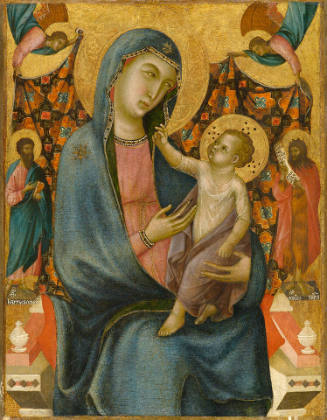
Master of San Torpé
circa 1300–1310


Unknown Lombard painter
circa 1400; altered circa 1472–1475