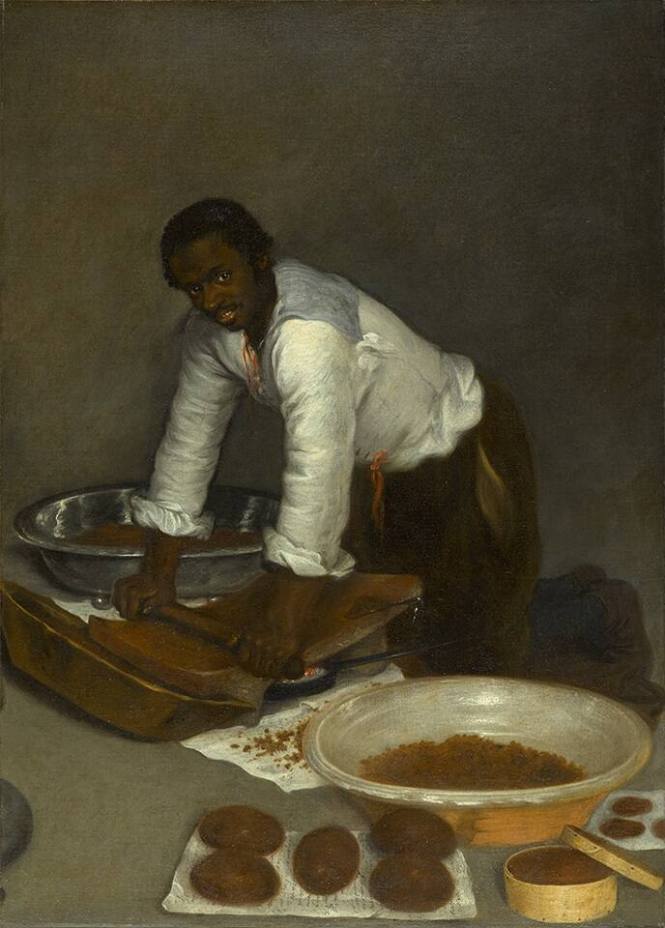
A Man Milling Cacao into Chocolate with a Metate and a Mano
Artist
Unknown Spanish painter
DateMid-late 17th century
MediumOil on canvas
Dimensions41 x 28 in. (104.1 x 71.1 cm)
Frame: 53 x 40 3/4 in. (134.6 x 103.5 cm)
Frame: 53 x 40 3/4 in. (134.6 x 103.5 cm)
ClassificationsPaintings
Credit LineGift of Mr. and Mrs. Benjamin Cone
Object numberG.69.20.1
On View
On viewCortés reportedly later said,” A cup of this precious drink permits man to walk for a whole day without food,” alluding to the potential exploitative use of chocolate among enslaved laborers. Following European contact with the Americas, free Africans were treated as human commodities in the Hispanic world through the transatlantic slave trade. Africans were sold into enslavement in Spanish, European and American markets, generating an ingrained association between “Blackness” and “enslavement” until the nineteenth century.
[Carmen Fracchia, Professor of Hispanic Art History, School of Arts, Birkbeck University of London, 2023]
A cross between a portrait, a still life, and a genre scene, this painting is unique in seventeenth-century art. An unidentified man of African descent working in a Spanish household, either as an enslaved or recently emancipated person, prepares chocolate using a pestle (mano) and grinding stone (metate). The milling of cacao over heat draws out the liquor, yielding a paste that hardens upon cooling (here as rounds). The depicted activity resembles traditional Mesoamerican chocolate preparation as transmitted to Spain by colonial settlers. The painting thus encapsulates two interrelated practices that propelled the Spanish imperial economy: the widespread enslavement of individuals and appropriation of resources, goods, and customs from subjugated cultures.
[L. Humphrey, April 2023]
ProvenanceDuke of Bedford [?]; Victor Behar, London, ca. 1946-51/52; [Mr. and] Mrs. Benjamin Cone, Greensboro, NC (gift from Behar - deceased); given to NCMA, 1969.Published References"Acquisitions," North Carolina Museum of Art Bulletin 9, nos. 1 and 2 (December 1969), listed 56, illus. (b-w) 69 (as Moorish Servant by Antonio Puga).
Claire Clifton, The Art of Food: Culinary inspirations from the paintings of the great masters (New Jersey: The Wellfleet Press, 1989), 122, illus. (color) 123.
L. E. [Lisa Eveleigh], "Private Collectors Share Their Art," North Carolina Museum of Art Preview (Autumn 1992), mentioned and illus. (b-w) 14.
Marianna Haraszti - Takacs, Spanish Genre Painting in the Seventeenth Century (Budapest: Adakemia Kiado, 1983), cat. no. 196.
Edward J. Sullivan, Catalogue of Spanish Paintings (Raleigh: North Carolina Museum of Art, 1986), cat. no. 31, illus. (b-w) 97, also briefly discussed xiv and illus. (color) xv.
Introduction to the Collections, rev. ed. (Raleigh: North Carolina Museum of Art, 1992), illus. (b-w) 213.
Dennis Weller, entry for A Man Scraping Chocolate, in North Carolina Museum of Art: Handbook of the Collections, Rebecca Martin Nagy, ed. (Raleigh: North Carolina Museum of Art, 1998), 157, illus. (color).
Janet M. Torpy, M.D., "The Cover," JAMA: The Journal of the American Medical Association 287, no. 19 (May 15, 2002), discussed 2466, illus. (color) 2457, and cover.
Dennis P. Weller, entry for A Man Scraping Chocolate, in North Carolina Museum of Art: Handbook of the Collections, rev. ed. (Raleigh: North Carolina Museum of Art, 2010), 318, illus. (color) 319.
Rabbi Deborah R. Prinz, On the Chocolate Trail: A Delicious AdventureConnecting Jews, Religions, History, Travel, Rituals and Recipes to the Magic of Cacao (Woodstock, VT: Jewish Lights Publishing, 2013), illus. (b-w) 54.
Pia Baggi Sasini, Bello da Mangiare: Good Enough to Eat (Milan: Nexo, 2012), illus. (color) 273.
Gloria K. Fiero, The Humanistic Tradition, Book 4: Faith, Reason, and Power in the Early Modern World, 7th ed. (Boston, etc.: McGraw Hill Education, 2015), briefly discussed and illus. (color) 185, fig. 26.12.
Lisandra Estevez, “(Re-) presenting Africans in Early Modern Spain and Latin America,” in Notes on Early Modern Art 4, no. 1 (Ramsey, NJ: Zephyrus Scholarly Publications, LLC, 2017), discussed 12–22, illus. (color) 13, fig. 1.
Luke Whisnant, "Thirteen Ways of Looking at A Man Scraping Chocolate" in “You Are the River: Literature Inspired by the North Carolina Museum of Art,” edited by Helena Feder (Raleigh, NC: North Carolina Museum of Art, 2021), illus (color) 66. (as "A Man Scraping Chocolate").
Peter Brathwaite, Rediscovering Black Portraiture (Los Angeles: Getty Publications, 2023), illus. (color) 70, as A Man Scraping Chocolate.
North Carolina Museum of Art, "The People's Collection," (Raleigh, NC; North Carolina Museum of Art, 2024), illus. (color) 205.Exhibition HistoryRaleigh, NC, North Carolina Museum of Art, “Paintings from N.C. Collectors,” October 3-24, 1954, catalogue.
Birmingham, AL, Birmingham Museum of Art, “Art of Spain,” March 19-April 5, 1971, cat. p. 36.
Raleigh, NC, North Carolina Museum of Art, "The People's Collection, Reimagined," October 7, 2022–present. Object Rights Statement
The North Carolina Museum of Art (NCMA) makes images of its collection available online to support research and scholarship and to inform and educate the public. Certain works of art, as well as the photographs of those works of art, may be protected by copyright, trademark, or related interests not owned by the NCMA. The responsibility for ascertaining whether any such rights exist and for obtaining all other necessary permissions remains with the applicant. To request images and/or permissions from the NCMA, please complete our online request form.
Unknown Lombard painter
circa 1400; altered circa 1472–1475

Northern French painter (Picardy)
circa 1470

Juan Bautista Romero
circa 1775–1790




Giuseppe Vittore Ghislandi, called Fra Galgario
circa 1720–1730