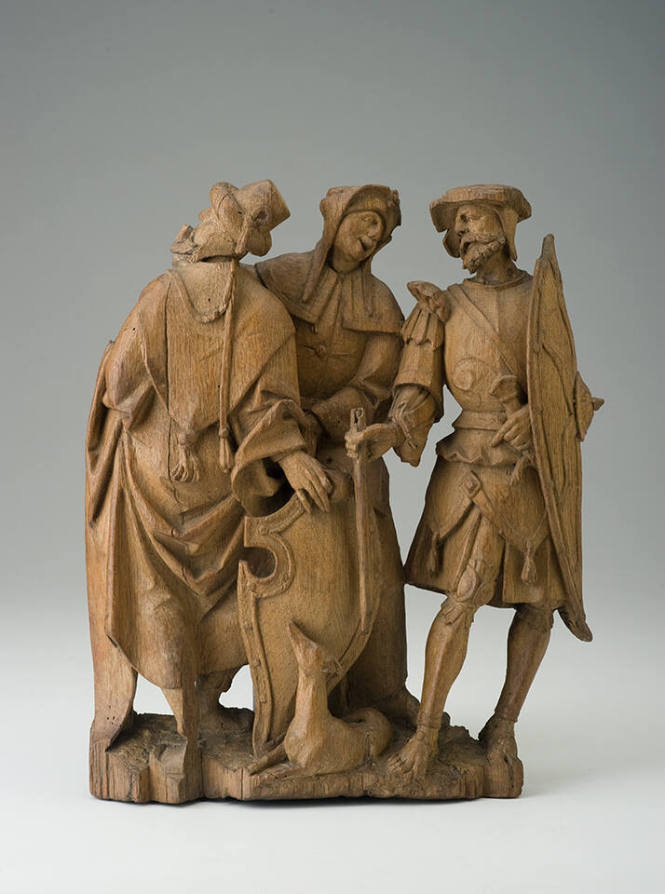
Figures from a Crucifixion from an Antwerp Altarpiece: Soldiers Group
Datecirca 1520–1525
Mediumoak with traces of polychromy
Dimensions17 x 14 in. (43.2 x 35.6 cm)
ClassificationsSculpture
Credit LinePurchased with funds from the State of North Carolina
Object number61.1.5
On View
On viewA miniature impression of a hand—a carver’s mark—on top of each composition points to their manufacture in early sixteenth-century Antwerp, where teams of artisans created painted wooden altarpieces in large numbers for export throughout Europe. Although the Reformation eliminated some markets for these elaborate multimedia works, their makers apparently adapted the imagery to suit both Catholic and Protestant patrons.
[L. Humphrey, “The People’s Collection, Reimagined,” 2026]ProvenanceProduced in the city of Antwerp, South Netherlandish region of Brabant, about 1520–1530. [Edward R. Lubin, Inc. Works of Art, New York, NY, by 1961] [1]; acquired by the North Carolina Museum of Art, 1961.
[1] Dealer was unable to furnish ex-collection information to NCMA “as it is still a source.”
Published References“Accessions of American and Canadian Museums: October–December, 1961,” The Art Quarterly (Spring 1962), 86, illus. (b-w), 73 and cover.
Justus Bier, “Director’s Report,” North Carolina Museum of Art Bulletin 4, nos. 2 and 3 (Winter–Spring 1964), 3–22 at 9.
“Selections from Acquisitions of the Biennium,” North Carolina Museum of Art Bulletin 4, nos. 2 and 3 (Winter–Spring 1964), fig. 10, 42, fig. 12, 43.
"Biennial Report of Registrar’s Department and Library," North Carolina Museum of Art Bulletin 4, nos. 2 and 3 (Winter–Spring 1964), 64 (as The Fainting Mary, Supported by Saint John the Evangelist and Mary Magdalene and The Centurion Recognizing Christ and Two Mocking Soldiers).
Object Rights Statement
The North Carolina Museum of Art (NCMA) makes images of its collection available online to support research and scholarship and to inform and educate the public. Certain works of art, as well as the photographs of those works of art, may be protected by copyright, trademark, or related interests not owned by the NCMA. The responsibility for ascertaining whether any such rights exist and for obtaining all other necessary permissions remains with the applicant. To request images and/or permissions from the NCMA, please complete our online request form.
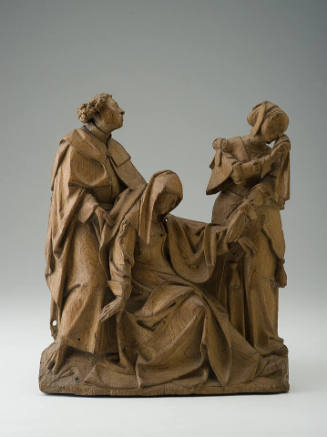
South Netherlandish artist
circa 1520–1530