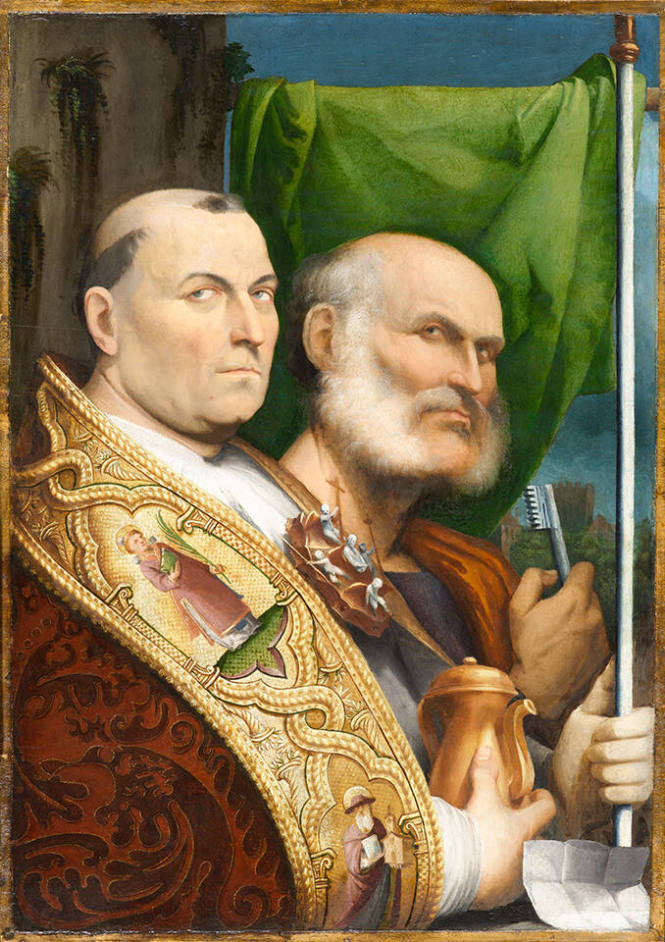
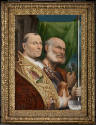
Left wing of an altarpiece for San Salvatore Castle at Susegana: Saints Prosdocimus and Peter
Artist
Giovanni Antonio da Pordenone
b. 1483 (?), Pordenone; d. 1539 (?), Ferrara
Datecirca 1515–1517
MediumOil on poplar panel, mounted on plywood panel
Dimensions34 1/2 x 24 1/8 in. (87.6 x 61.3 cm)
Frame: 44 1/2 x 34 1/4 x 4 1/2 in. (113 x 87 x 11.4 cm)
Frame: 44 1/2 x 34 1/4 x 4 1/2 in. (113 x 87 x 11.4 cm)
ClassificationsPaintings
Credit LineGift of the Samuel H. Kress Foundation
Object numberGL.60.17.43
On View
On viewThis panel is one of three components of an altarpiece commissioned for the Collalto family castle in the Veneto foothills. The central panel survives in Milan, but the right wing, depicting saints John the Baptist and Jerome, is lost.
[L. Humphrey, “The People’s Collection, Reimagined,” 2025]
ProvenancePresumably commissioned for the high altar of the Capella Vecchia, castello San Salvatore, Susegana (Treviso), IT ca. 1515 by a member of the House of Collalto, possibly Count Antonio III di Collalto (1471–1528) [1]; relocated from the Cappella Vecchia to the hall of the Castello di San Salvatore between 1851 and 1871 [2]; transferred on March 27, 1916 to the Filanda Collalto, Susegana (the Collalto family’s silk-spinning mill) [3]; transferred by Manfred Eduard 5th prince of Collalto e San Salvatore (1870–1940) to the Collalto manor in Staatz, Lower Austria on December 25, 1917 [4]; [Hugo Engel (1883–1963), Vienna, Austria, by 1926] [5]; [acquired by Thos. Agnew & Sons, London and New York, October 1, 1926] [6]; [sold to Giuseppe Bellesi as agent for Alessandro Contini Bonacossi (1878–1955), Rome-Florence, May 2, 1946] [7]; sold to the Samuel H. Kress Foundation, New York on July 17, 1950, inv. K1798 [8]; given to the NCMA in 1961.
[1] This work was likely commissioned as the left wing of a tripartite altarpiece whose central panel with the Transfiguration of Christ (oil on panel, 87 x 58 cm) is now preserved in the Pinacoteca di Brera, Milan (no. 937), and right wing, depicting Saints John the Baptist and Jerome in half length, is lost. Accounts from the 17th through 19th centuries assumed that the half-length panels were part of the complete altarpiece. This came under speculation after Fiocco 1921 doubted the half-length panels as intended for the altarpiece. However, Cohen 1996, 542–543 rejected these claims and proposed that Pordenone painted the Transfiguration in 1515 and the two wings about a year or two later, resulting in a triptych.
The earliest published testimony of the in-situ altarpiece comprising half-length saints John the Baptist and Jerome (right wing), Transfiguration (center), and NCMA panel (left wing) is Ridolfi 1648 (ed. von Hadeln 1914), 120, who refers to it as “nell’Altare” (on the altar). Later scholars including De’ Renaldis (1798), Di Maniago (1819) and Moro and Zanotto (1851) specified its location on the “altar maggiore” (high altar).
[2] Crowe and Cavalcaselle 1871, vol. 2, 246 (as “formerly on the altar and now in the castle”). See also Crowe and Cavalcaselle (ed. Borenius 1912), vol. 3, 139-140; Cavalcaselle 1876 (ed. Bergamini 1973), 64; 1914 edition of Ridolfi 1648, 120n4; Battistella 1929, 95; Fiocco 1943, 112 (as seen in the castle in 1914); Cohen 1996, vol. 2, 558. See also “Provenance” in the Kress Collection Digital Archive record for this painting.
[3] A letter dated October 28, 1921 from Angelo Lollini, Intendente di Finanza of Treviso, to Prof. Oreste Battistella, Ispettore Onorario ai Monumenti (transcribed in Passolunghi 2006, 202–204, no. 21) testifies that on March 27, 1916, two wooden crates of paintings—both made of white fir bound crosswise with wire and sealed with lead seals—were transferred from the castle to the care of Vittorio Levade, director of the Filanda Collalto, for safekeeping. One crate contained the NCMA panel, the related Saints John the Baptist and Jerome, and an unknown nude portrait; the other contained the Transfiguration, a Nativity scene, and a painting of Adam and Eve. Also according to this letter, the two chests were subsequently transported from the silk mill to the house of a farmer in nearby Falzè di Piave, IT.
The castello San Salvatore itself faced immense destruction during World War I. After Italy declared war on Austria-Hungary on May 23, 1915, fighting began almost immediately along its northeastern border. Following the Battle of Caporetto (October 24–November 19, 1917), Austro-Hungarian forces seized control of Susegana and occupied the castle. While retreating, the Italians attempted to destroy it with fire and artillery shells, but were unsuccessful. The castle interior was likewise ransacked. The Germans had been ordered to recover all valuable objects from the castle; Austro-Hungarian officers removed some of the castle furnishings. In December 1917, Italian forces bombarded the Cappella Vecchia, destroying Pordenone’s fresco cycle. On this history, see Moschetti 1932, fig. 186 and Passolunghi 2006, 201–202.
[4] According to a 1927 letter from Abbate Luigi Bailo (1835–1932), director of the Biblioteca Civica of Treviso, to Antonio Bailo (presumably a relative), Conte Manfredo di Collalto (Manfred Eduard, 5th prince of Collalto e San Salvatore; 1870–1940) arrived at the castello San Salvatore at Christmas 1917 to safeguard some of its art from plunder (letter transcribed in Passolunghi 1990, 97-99, no. 13; Passolunghi 2006, 95–99, no. 24). The abbot recounted that the count had managed to save Pordenone’s Transfiguration and a panel by Girolamo de Treviso. (Whether Bailo believed that Manfred had rescued just the single panel with the Transfiguration or the entire altarpiece is unclear.) Based on this evidence, Cohen 1996, vol 2, 540 and Passolunghi 2006, 206 concluded that only the Transfiguration was taken to Staatz during World War I.
Moschetti 1932, 206–210 provided further details. He stated that the “triptych” (that is, the Transfiguration flanked by two saints on either side) was brought by its owner to the Collalto’s ancestral manor in Staatz (Lower Austria) along with two other paintings formerly in the Cappella Vecchia: Girolamo da Treviso’s ancona and a 1511 pala by Pordenone. Moschetti further reported that all three paintings were traced to Austria by Ettore Modigliani, director of the Pinacoteca di Brera, who repatriated them to Italy. Subsequently, the Transfiguration was assigned to the Brera, whereas the other two paintings (Pordenone’s 1511 pala and Girolamo da Treviso’s ancona) were assigned to the Accademia in Venice. Moschetti makes no mention of the disposition of the Transfiguration’s side panels. These events are summarized in Furlan 1990, 457 and Humfrey 1990, 111. Humfrey additionally reported that the half-length panels had been sold.
Manfred Eduard, who lived in Staatz from 1911, had inherited vast properties there through his paternal grandmother, Ida Colloredo-Mannsfeld (1816–1857), and likely orchestrated the transfer of the Pordenone altarpiece from Italy to Austria. On the Collalto dominion in Staatz, see Franz Xaver Schweickhardt, Darstellung des Erzherzogthums Oesterreich unter der Ens…: Viertel unterm Manhartsberg, Bd. 6 (Vienna: PP. Mechitaristen, 1835), 194–211; Jan Koumar, “Quotidian Life of Aristocracy in the First Czechoslovak Republic. The Case of the House of Collalto e San Salvatore,” West Bohemian Historical Review XII, 1 (2022): 19–45 at 24–25, 32.
[5] Thos. Agnew & Sons stock records indicate that the painting was purchased from Hugo Engel; see Thos. Agnew & Sons stock records, Picture Stock Book 11, NGA27/1/13, Thos. Agnew & Sons Ltd Archive, National Gallery of Art, London. Engel (1883–1963) was an Austrian art dealer who primarily supplied other dealers. In 1926, he was working from Vienna in the 2nd district, Leopoldstadt, at Große Mohrengasse 14. From there he ran a business selling Old Master paintings (Gemälde alter Meister). For a brief biography on Engel, see Gabriele Anderl, “Hugo Engel” in Lexikon der österreichischen Provenienzforschung, Kommission für Provenienzforschung, July 1, 2025, https://www.lexikon-provenienzforschung.org/en/engel-hugo.
[6] On October 1, 1926, Agnew’s acquired the painting as Pope Leo and St. Peter by G. A. Pordenone, from Hugo Engel; see NGA27/1/13. Stock book details of works shipped to New York by Thos. Agnew & Sons, NGA27/11/1/244, indicates that on October 14, 1926, the painting was shipped to New York aboard the S.S. La Savoie, a French ocean liner; the title of the painting was listed as Two Saints. The painting appeared in Agnew’s New York exhibition that opened November 19, 1926; see Exhibition of Paintings by Old Masters of the Venetian School (New York: Agnew, 1926), cat. no. 8; see also Washburn Freund 1927, 243–244; Schwarzweller 1935, 26 (as on the art market in 1935); Fiocco 1939, 136 (as formerly at Agnew’s, London); Fiocco 1943, 112 (as whereabouts unknown, but previously at Agnew’s London); and Roberto Longhi’s handwritten note dated March 20, 1950, authentication photograph (object file, NCMA), stating that “after 1914 the painting went to Colin Agnew, London.”
[7] Thos. Agnew & Sons sold the painting to Giuseppe Bellesi on May 2, 1946; see NGA27/1/13. Bellesi was a London dealer and agent for Alessandro Contini Bonacossi, an art dealer based in Florence and Rome. For Bellesi and Bonacossi’s relationship, see: “Bellesi,” Fondazione Federico Zeri, Università di Bologna, https://fondazionefedericozeri.github.io/Mercato_dell_arte/html/dettagli/dettaglio_BE_II.html, accessed July 27, 2026.
[8] See “Provenance” in the Kress Collection Digital Archive record for this painting.Published ReferencesCarlo Ridolfi, Le Maraviglie dell’arte (Venice: Giovanni Battista Sgava, 1648), ed. Detlev Freiherrn von Hadeln, vol. 1 (Berlin: G. Grote'sche Verlagsbuchhandlung, 1914), 120 (in the life of Pordenone: “e nella Chiesa Vecchia del loro Castello…vidi nell’ Altare una picciola historietta della Trasfiguratione del Signore, e dalle parti in mezze figure al naturale li Santi Prodocimo, Pietro, Gio: Battista e Girolamo, che non si possono avvanzare in delicatezza e finimento”).
Girolamo De Renaldis, Della pittura friulana: saggio storica (Udine: Fratelli Pecile, 1798), 37.
Domenico Maria Federici, Memorie trevigiane sulle opere di disegno, vol. 2 (Venice: Francesco Andreola, 1803), 12.
Fabio di Maniago, Storia delle belle arti friulane (Venice: Giuseppe Picotti, 1819), 53, 144n40.
Fabio di Maniago, Storia delle belle arti friulane, 2nd ed. (Udine: Fratelli Mattiuzzi, 1823), 76, 203n40.
Lorenzo Crico, Lettere sulle belle arti trivigiane (Treviso: Tipografia Andreola, 1833), 120–121.
Marco Moro and Francesco Zanotto, Treviso e la sua provincia figurato in 24 vedute litografiche designate da Marco Moro con illustrazioni di Francesco Zanotto (Venezia: Giovanni Brizeghel, 1851; reprint, Bologna: 1973), pl. 2.
Giovanni Battista Cavalcaselle, Disegni e appunti, ca. 1857–1866, ms. Ital. IV 2031 [12272], fascicolo VII, Cartella E, fol. 131v, Biblioteca Nazionale Marciana, Venice (sketches of works by Pordenone in San Salvatore di Collalto, including NCMA panel, half-length saints John the Baptist and Jerome, and the Transfiguration).
J. A. Crowe and G. B. Cavalcaselle, A History of Painting in North Italy: Venice, Padua, Vicenza, Verona, Ferrara, Milan, Friuli, Brescia, from the Fourteenth to the Sixteenth Century, vol. 2 (London: John Murray, 1871), 238–247 at 246; 2nd ed., vol. 3, Tancred Borenius, ed. (London: John Murray, 1912), 139–140.
Giovanni Battista Cavalcaselle, La pittura friulana del Rinascimento (unpublished, 1876); ed. G. Bergamini (Venice: Neri Pozza Editore, 1973), 64.
Giuseppe Fiocco, “Pordenone ignoto,” Bollettino d’Arte del Ministero della Pubblica Istruzione, Anno 1, Serie 2, no. 5 (November 1921), 196, 200, fig. 7.
An Exhibition of Paintings by Old Masters of the Venetian School (New York: Thos. Agnew & Sons, Inc., 1926), cat. no. 8 (as St. Peter with Ecclesiastic by Giovanni Pordenone)
Frank E. Washburn Freund, “Vom amerikanischen Kunsthandel,” Der Cicerone 19, no. 8 (April 1927), 239–249 at 242 fig. 5, 243–244.
Adolfo Venturi, Storia dell’arte italiana: La Pittura del Cinquecento, vol. 9, part 3 (Milan: Ulrico Hoepli, 1928), 653.
Oreste Battistella, I conti di Collalto e San Salvatore e la Marca Trevigiana (Treviso, 1929), 95, 103.
Bernhard Berenson, Italian Pictures of the Renaissance (Oxford: Clarendon Press, 1932), 469 (Transfiguration only).
Andrea Moschetti, I danni ai monumenti e alle opere d'arte delle Venezie nella guerra mondiale MCMXV–MCMXVIII, Istituto federale di credito per il risorgimento delle Venezie, Quaderno, no. 65 (1929), 23, 50, 52.
Andrea Moschetti, I danni ai monumenti e alle opere d’arte delle Venezie nella guerra mondiale 1915–1918 (Venice: Ferrari, 1932), 206–208.
“Pordenone, The Transfiguration,” in Catalogue of the Royal Brera Gallery (exhibition catalogue) (Milan: Royal Brera Gallery, 1933), 71, cat. no. 934 (no mention of the side panels).
Ettore Modigliani, Catalogo della Pinacoteca di Brera (Milan: 1935), 68 (notes that the Transfiguration was donated to the Italian state in 1925; no mention of the side panels).
Kurt Schwarzweller, “Giovanni Antonio da Pordenone” (PhD diss., Universität Göttingen, 1935), 34–36, 129n24, 135, 144 (panels dated to c. 1530/1535).
Kurt Schwarzweller, Giovanni Antonio da Pordenone (Frankfurt am Main-Schwanheim: Henrich, 1937).
Giuseppe Fiocco, Giovanni Antonio Pordenone (Udine: La Panarie, 1939), 40–42, 136, pl. 37.
Sergio Bettini, “Giovanni Antonio da Pordenone,” Emporium 90 no. 535 (1939), 63–76 at 64.
Sergio Bettini, “La pittura friulana del Rinascimento e Giovanni Antonio Pordenone,” Le Arti 1 no. 5 (1939), 464–480 at 474.
Bruno Molajoli, Mostra del Pordenone e della pittura friulana del Rinascimento (exhibition catalogue) (Udine: Castello, 1939), 68.
Giuseppe Fiocco, Giovanni Antonio Pordenone, 2nd ed. (Padua: Le Tre Venezie, 1943), 33, 34, 35n7, 112 pl. 37.
Bernard Berenson, Italian Pictures of the Renaissance: Venetian School, vol. 1 (London: The Phaidon Press, 1957), 144–45, pl. 857.
Fern Rusk Shapley with W. R. Valentiner, The Samuel H. Kress Collection (Raleigh: North Carolina Museum of Art, 1960), 88, illus. (b-w) 89.
Fern Rusk Shapley with W. R. Valentiner, The Samuel H. Kress Collection (Raleigh: North Carolina Museum of Art, 1965), 88, illus. (b-w) 89.
I[talo] Furlan, Giovanni Antonio Pordenone (Bergamo: 1966), 45.
Fern Rusk Shapley, Paintings from the Samuel H. Kress Collection: Italian Schools XV–XVI Century, vol. 2 (London: The Phaidon Press, 1968), 171, 401, fig. 409.
Michelangelo Muraro, “Del Pordenone e della principale linea di sviluppo della sua arte,” Ateneo Veneto 9 (1971), 163–180 at 166.
Charles E. Cohen, “Giovanni Antonio da Pordenone,” 2 vols. (unpublished PhD diss., Harvard University, 1971), vol. 1 172–175, vol. 2 84–88, 104–106.
L. Dell’Agnese Tenente, “Sull’attività giovanile del Pordenone: la formazione e le esperienze romane,” Arte Veneta 26 (1972), 41.
Mauro Lucco, “Pordenone a Venezia,” Paragone 26, no. 309 (November 1975), 7–8, 12, 21.
Charles E. Cohen, The Drawings of Giovanni Antonio da Pordenone (Firenze: La Nuova Italia Editrice, 1980), 43, 71–72, 177, fig. 11.
Mauro Lucco, “La giovinezza del Pordenone (nuove riflessioni su vecchi studi),” in Giornata di studio per il Pordenone, ed. Paola Ceschi Lavagetto (Piacenza: 1982), 41.
Giuseppe Bergamini and Sergio Tavano, Storia dell’arte nel Friuli-Venezia Giulia (Reana del Rojale: 1984), 340.
Caterina Furlan and M. Bonelli, Il Pordenone a Travesio (Udine: 1984), 24.
Caterina Furlan, “Rivisitando il Pordenone: congetture, ipotesi, proposte,” in Il Pordenone, ed. Caterina Furlan (exhibition catalogue) (Milan, Electa: 1984), 58–60 (catalogue mention only).
Charles E. Cohen, “Ritratto frontale a busto intero di un uomo con un berretto,” in Il Pordenone, ed. Caterina Furlan (exhibition catalogue) (Milan: Electa, 1984), 196 (catalogue mention only).
Caterina Furlan, Il Pordenone (Milan: Electa, 1988), 19, 39, 72–74, illus. 72, 91, 327.
Pier Angelo Passolunghi, Catalogo per Susegana (Susegana: Amministrazione Comunale, 1989), 53, 56, 62, 94, 99, pl. 30, 162, illus. 163.
Peter Humfrey, La pittura veneta del Rinascimento a Brera (Florence: Cantini, 1990), 111–112.
Caterina Furlan in Pinacoteca di Brera: Scuola veneta (Milan: Pinacoteca di Brera, 1990), 456–459 at 457.
Paolo Goi, “Vero, dipinto, donato, perduto: Percorso alternativo attraverso i metalli preziosi del Friuli-Venezia Giulia,” in Ori e tesori d’Europa, Atti del convegno di studio, eds. Giuseppe Bergamini and Paolo Goi (Udine: 1992), 424.
David Steel, “Cima’s Madonna and Child in a Landscape,” Preview (Winter 1993), illus. (b-w) 14.
Marilena Tamassia, Collezioni d’arte tra Ottocento e Novecento: Jacquier fotografi a Firenze, 1870–1935 (Naples: Electa Napoli, 1995), 42-43, no. 44934 (photograph commissioned by Bernard Berenson).
Charles E. Cohen, The Art of Giovanni Antonio da Pordenone, 2 vols. (Cambridge: Cambridge University Press, 1996), vol. 1:104n23, 127; vol. 2:517, 540–543, cat. 19, 557, 558, cat. 25a, cat. 25b, illus. (b-w), fig. 137, 138 (half-length panels created after the central panel, but designed for that specific altarpiece).
Luisa Arrigoni, Emanuela Daffra, and Pietro C. Marani, The Brera Gallery: The Official Guide (Milan: Touring Club Italiano, 1998), 125, no. 1.
Pier Angelo Passolunghi, Susegana: Memoria storico-artistica nel Bicentenario della nascita del Comune (Treviso: Comune di Susegana, 2006), 164, 198, fig. 82, 272–277 at 272.
Giorgio Fossaluzza, “Conegliano, Ceneda e Serravalle: ‘città intermedie’ e crocevia di esperienze pittoriche nel primo Cinquecento,” in Un CinQuecento inQuieto: da Cima da Conegliano al rogo di Riccardo Perucolo (Venice: Marsilio, 2014), 82, 84, illus. 86.
Tatiana Calmasini, “Il ‘nemico interno’ a Treviso durante la Grande guerra: Reprimere, sorvegliare, recludere” (tesi di laurea, Università Ca’Foscari Venezia, 2014/2015), 88.
Angelica Daneo, ed. Glory of Venice: Masterworks of the Renaissance (exhibition catalogue) (Denver: Denver Art Museum, 2016), cat. no. 39, illus. 100.
Marco Tanzi, “Fogolino in Friuli: pittore, assassin, spia,” in Ordine e bizzarria: Il Rinascimento di Marcello Fogolino (exhibition catalogue), ed. Giovanni Carlo Federico Villa et al. (Trento: Castello del Buonconsiglio, 2017), 145–146, illus. 146, fig. 53.
Catherine R. Puglisi and William L. Barcham, Art and Faith in the Venetian World Venerating Christ as the Man of Sorrows (London: Harvey Miller, 2019), 148, 151, illus. 150, fig. 109.
Kress Collection Digital Archive, National Gallery of Art, accessed 6/15/26, https://kress.nga.gov/Detail/objects/3068.
“SS. Prosdocimus and Peter,” Frick Art Reference Library Photoarchive, accessed 7/11/26,
https://library.frick.org/permalink/01NYA_INST/no2n2l/alma991013094989707141.Exhibition HistoryNew York, NY, Thomas Agnew & Sons, Inc., “Paintings by Old Masters of the Venetian School,” November 18–December 31, 1926.
Denver, CO, Denver Art Museum, “Glory of Venice: Masterworks of the Renaissance,” October 2, 2016–February 12, 2017; Raleigh, NC, North Carolina Museum of Art March 4–June 18, 2017.
Raleigh, NC, North Carolina Museum of Art, “Venice and the Ottoman Empire,” September 28, 2024–January 5, 2025.
Object Rights Statement
The North Carolina Museum of Art (NCMA) makes images of its collection available online to support research and scholarship and to inform and educate the public. Certain works of art, as well as the photographs of those works of art, may be protected by copyright, trademark, or related interests not owned by the NCMA. The responsibility for ascertaining whether any such rights exist and for obtaining all other necessary permissions remains with the applicant. To request images and/or permissions from the NCMA, please complete our online request form.
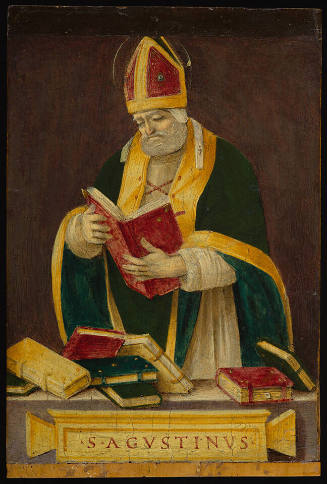
Filippino Lippi
circa 1496

Filippino Lippi
circa 1496

Unknown German artist
circa 1450

Unknown German artist
circa 1450
Raphael (Raffaello Sanzio or Santi)
1502–1503
Guariento di Arpo
circa 1360
Master of the Bologna Polyptychs
circa 1320
![Devotional painting for a Florentine guild (Guild of Doctors and Apothecaries?): Saints Cosmas and Damian; [Left predella]: Miracle of the Transplantation of the Black Leg; [Right predella]: Decapitation of Saints Cosmas and Damian](/internal/media/dispatcher/14751/thumbnail)