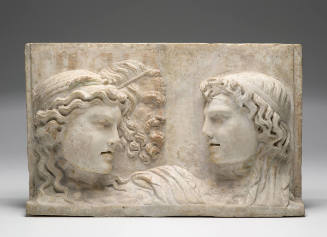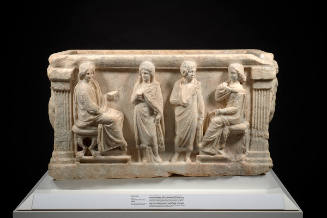

Funerary Stele of Dionysios and Tertia
Artist
Unknown
Datecirca 180–200
MediumMarble
DimensionsMax. Dimensions: 60 1/4 x 34 x 8 in. (153 x 86.4 x 20.3 cm)
ClassificationsSculpture
Credit LineGift of Mr. and Mrs. Gordon Hanes
Object numberG.79.6.13
On View
On viewThe accompanying visual elements, such as the scroll, sacrificial knife, mirror, and spindle, are items of everyday life that identify the profession, status, and roles of the deceased. The spindle and mirror identify Tertia in the traditional roles expected of women in ancient Rome: wife, mother, and homemaker.
[C. Rocheleau, "The People's Collection, Reimagined," 2022]ProvenanceProvenience unknown. Private collection, Germany, by 1970s [1]; [McAlpine Ancient Art, London]; Gordon Hanes (1916–1995) and Helen Copenhaver “Copey” Hanes (1917– 2013), Winston-Salem, NC, 1979; given to NCMA, 1979.
[1] Letter from McAlpine to Mary Ellen Soles, dated February 20, 1989. This collection has yet to be identified.Published ReferencesWaelkens, M. 1985. “17. Gable of a funerary stele.” The Malcove Collection, edited by Sheila Campbell. Toronto: University of Toronto. 22.
Lochman 1986. Eine Gruppe von phrygischen Grabstelen im Antikenmuseum Basel + Sammlung Ludwig. Unpublished thesis. Basel: Universität Basel. [page reference unknown], plate V, ill. 19;
Introduction to the Collections, rev. ed. (Raleigh: North Carolina Museum of Art, 1992), illus. (b-w) 35.
John Bodel and Stephen Tracy, Greek and Latin Inscriptions in the USA: A Checklist (New York: American Academy in Rome, 1997), 141.
Mary Ellen Soles, entry for Funerary Stele of the Priest Dionysios and His Wife, Tertia, in North Carolina Museum of Art: Handbook of the Collections, Rebecca Martin Nagy, ed. (Raleigh: North Carolina Museum of Art, 1998), 35, illus. (color).
Tomas Lochman, Studien zu kaiserzeitlichen grab- und votivreliefs Aus Phrygien (Basel: Skulpturhalle, 2003), p. 59 fn. 29, 66, 66 fn. 59, 100, 105 fn. 247, p. 260, cat no. II 92, tafel 8, fig. 29.
Mary Ellen Soles, entry for Funerary Stela of the Priest Dionysios and His Wife, Tertia, in North Carolina Museum of Art: Handbook of the Collections, rev. ed. (Raleigh: North Carolina Museum of Art, 2010), 72, illus. (color) 73.
Ute Kelp, Grabdenkmal und Lokale identität: Ein Bild der Landschaft Phrygien in der Römischen Kaiserzeit (Bonn: Dr. Rudolf Habelt GmbH, 2015), p. 78-79, 276, tafel 26, 3.
Exhibition HistoryRaleigh, NC, North Carolina Museum of Art, "The People's Collection, Reimagined," October 7, 2022–present. Object Rights Statement
The North Carolina Museum of Art (NCMA) makes images of its collection available online to support research and scholarship and to inform and educate the public. Certain works of art, as well as the photographs of those works of art, may be protected by copyright, trademark, or related interests not owned by the NCMA. The responsibility for ascertaining whether any such rights exist and for obtaining all other necessary permissions remains with the applicant. To request images and/or permissions from the NCMA, please complete our online request form.
Unknown Roman artist
circa 20 BCE–20 CE