
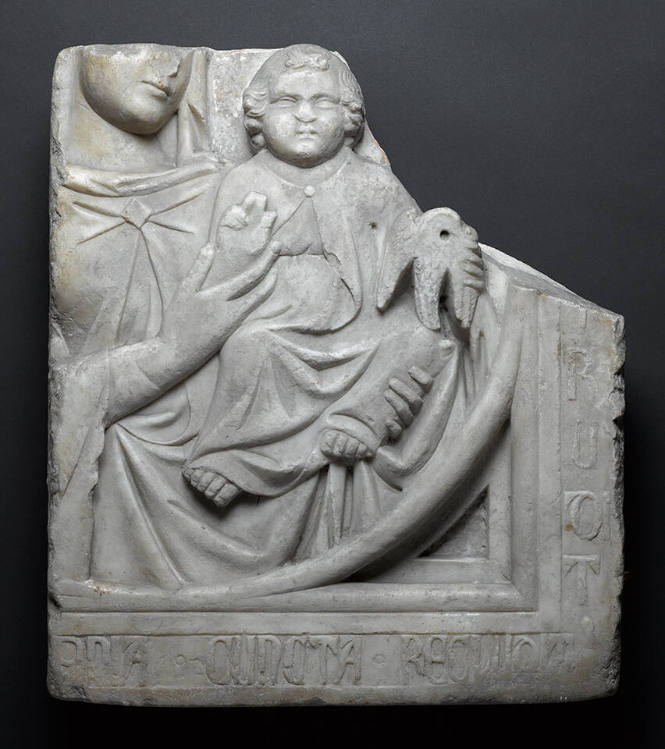
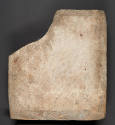
Relief from the Tomb of Bartolomeo di Capua (1248–1328), Naples Cathedral: Virgin and Child
Artist
Tino di Camaino
Italian, b. circa 1280, Siena; d. 1337, Naples
Date1328–1329
MediumMarble
Dimensions17 1/2 × 15 1/2 × 2 1/2 in. (44.5 × 39.4 × 6.4 cm)
ClassificationsSculpture
Credit LineGift of W. R. Valentiner
Object numberG.57.34.11
On View
On view[1] Seat of the Archbishop of Naples, the Cattedrale di Santa Maria Assunta is also widely known as the Cattedrale di San Gennaro in honor of the city’s patron saint. The now dismantled tomb was located in Bartolomeo di Capua’s family chapel, dedicated to Saints Peter and Paul, just outside the choir of the church. The chapel’s precise location was against the eastern face of the penultimate pillar of the southern nave, below the organ. According to Aceto 2011, 198, the present relief is from the front slab of the tomb, which was likely subdivided into three medallions, each containing a single half-figure, and surrounded on all four sides by a long inscription that began in the upper left margin. Aceto suggests that the Virgin and Child relief occupied the left medallion, a Man of Sorrows likely occupied the center, and a figure of a saint the right side.
Bartolomeo di Capua was protonotary and logothete of the Kingdom of Naples (chief clerk of the high court and chancellor).
[2] According to M. A. Lombardo di Cumia, 2008, 32–33, 75, 212–218, in 1586, the dilapidated 14th-century chapel was dismantled by the descendants of Bartolomeo di Capua and rebuilt in Renaissance style at the left end of the transept. On that occasion, Bartolomeo’s funerary monument was lost (G. A. Summonte, 1601-1643; C. D'Engenio, 1623). It is likely, however, that some parts of it were reused in the new tomb construction, which was first reduced in size (1805), and finally taken down (1842). The marbles disappeared after being deposited for some time in the archbishop's garden.
[3] That Valentiner purchased the sculpture during his years in Detroit is indicated by the fact that it was preserved in art storage in Detroit in July 1957, when Valentiner had it shipped from Detroit to North Carolina; see the receipt of shipment from Detroit Institute of Arts to NCMA on July 29, 1957 housed in the object file. Detroit Institute of Arts has no record of the relief’s purchase or provenance, nor any dealer correspondence related to its purchase. Since it was not included in Valentiner’s 1938 exhibition Italian Gothic and Early Renaissance Sculptures (January 7–February 20, 1938), it must have been acquired by Valentiner after that, and before he retired as director of Detroit in 1944 and moved to Los Angeles.
[4] NCMA Incoming Receipt, July 29, 1957, shipped from Eleanor Ferry, Detroit Institute of Arts. The purpose listed is “Property of W. R. Valentiner, returned.” On July 31, 1957, Valentiner wrote to the director of DIA, E. F. Richardson, to thank him for sending the relief. “I am glad to have even a fragment of Tino’s work around me.”Published ReferencesPietro de Stefano, Descrittione de i luoghi sacri della città di Napoli (Naples: Raymondo Amato, 1560), fol. 15r.
Pietro de Stefano, Descrittione dei luoghi sacri della città di Napoli, ed. Stefano D’Ovidio and Alessandra Rullo (Naples: Università degli Studi di Napoli “Federico II,” 2007).
Gio. Antonio Summonte, Dell’Historia della città, e regno di Napoli, 2nd ed., vol. 2 (Naples: Antonio Bulifon, 1675), 152, 380–381.
Cesare D’Engenio Carracciolo, Napoli sacra (Naples: 1623), 34.
Carlo de Lellis, Aggiunta alla Napoli sacra dell'Engenio Caracciolo (Naples, before 1689), Naples, Biblioteca Nazionale “Vittorio Emanuele III”, ms. X.B.20, ed. Elisabetta Scirocco and Michela Tarallo, vol. 1 (Naples and Florence, 2013), 58–59, https://guide.accademiadellacrusca.org/Upload/138.pdf.
Carlo De Lellis, Notamenta ex Registris Caroli II, Roberti et Caroli ducis Calabrie (Naples, 17th century), Archivio di Stato di Napoli, Ricostruzione angioina, vol. 3, fol. 17.
Bernardo De Dominici, Vite de’ pittori, scultori, ed architetti napoletani, vol. 1 (Naples: Stamperia del Ricciardi, 1742), 8.
Stefano D’Ovidio in Bernardo De Dominici, Vite de’ pittori, scultori ed architetti napoletani, vol. 1, ed. Fiorella Sricchia Santoro and Andrea Zezza (Rome: Edizioni Paparo, 2003), 82.
Lorenzo Loreto, Guida per la sola chiesa metropolitana cattedrale di Napoli (Naples: Dalla Tipografia Arcivescovile, 1849), 105–106.
Notizie del bello dell’antico e del curioso della città di Napoli raccolte dal Can.o Carlo Celano , vol. 2, ed. Giovanni Battista Chiarini (Naples: Stamperia Floriana, 1856), 186–187.
Camillo Minieri Riccio, Cenni storici intorno i grandi uffizii del Regno di Sicilia durante il regno di Carlo I d’Angiò (Naples: Stabilimento Tipografico Partenopeo, 1872), 135–155 at 144–145.
“Registrar’s Report of the New Acquisitions,” North Carolina Museum of Art Bulletin 1, no. 4–5 (Winter 1957, Spring 1958), 53.
May Davis Hill, “Madonna and Child Relief by Tino da Camaino,” North Carolina Museum of Art Bulletin 2, no. 1 (Summer 1958), 12–14 at 12, fig. 1.
Franco Strazzullo, Saggi storici sul Duomo di Napoli (Naples: Istituto Editoriale del Mezzogiorno, 1959), 94–95, 175–176.
Masterpieces of Art: In Memory of William R. Valentiner, 1880–1958 (exhibition catalogue) (Raleigh: North Carolina Museum of Art, 1959), 20, 36, cat. no. 3.
Medieval Art (exhibition catalogue) (Chapel Hill: William Hayes Ackland Memorial Art Center, 1961), 13–14, fig. 8.
Gert Kreytenberg, “Zum gotischen Grabmal des heiligen Bartolus von Tino di Camaino in der Augustinerkirche von San Gimignano,” Pantheon 46 (1988), 13–25, illus. 18.
Francesco Aceto, “Tino di Camaino a Napoli,” in Scultura gotica senese 1260–1350, ed. Roberto Bartalini (exhibition catalogue) (Siena: Fondazione Monte dei Paschi; Torino: Umberto Allemandi & Co., 2011), 183–233 at 198, cat. no. 5, 220–221.
Maria Alasia Lombardo di Cumia, La topografia artistica del Duomo di Napoli: dalla fondazione angioina alla "riforma" Settecentesca del cardinale Giuseppe Spinelli (Naples: Paparo, 2011), 180–186, 307–309 (pianta ricostruttiva 1, letter O); 319 (pianta ricostruttiva 6, letter E); 321–322 (pianta costruttiva 7, lettera E).Exhibition HistoryRaleigh, NC, North Carolina Museum of Art, “Masterpieces of Art: In Memory of William R. Valentiner, 1880-1958,” April 6–May 17, 1959, cat. no. 3.
Chapel Hill, NC, Ackland Art Center, “Medieval Art,” April 28–May 20, 1961, cat. no. 8.
Object Rights Statement
The North Carolina Museum of Art (NCMA) makes images of its collection available online to support research and scholarship and to inform and educate the public. Certain works of art, as well as the photographs of those works of art, may be protected by copyright, trademark, or related interests not owned by the NCMA. The responsibility for ascertaining whether any such rights exist and for obtaining all other necessary permissions remains with the applicant. To request images and/or permissions from the NCMA, please complete our online request form.

Tino di Camaino
1318–1320


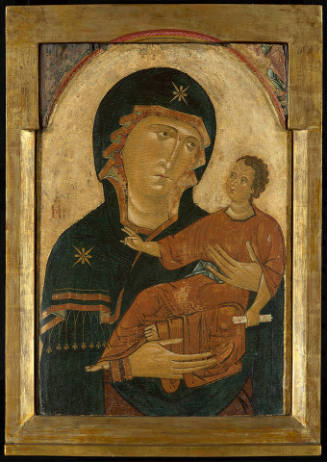
Berlinghiero di Melanese
circa 1225–1250


Mariotto di Nardo
circa 1400–1410