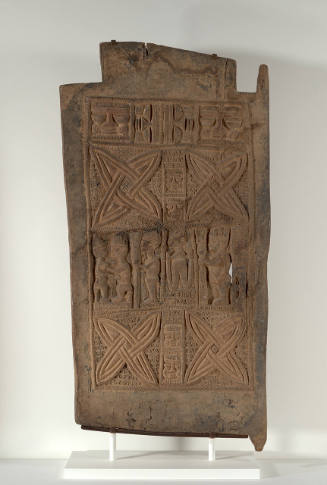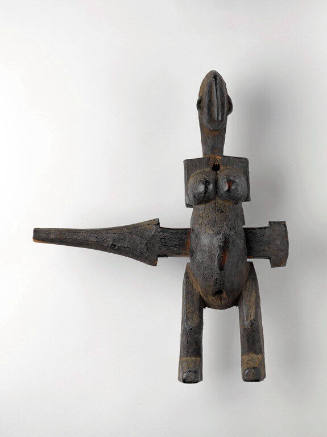
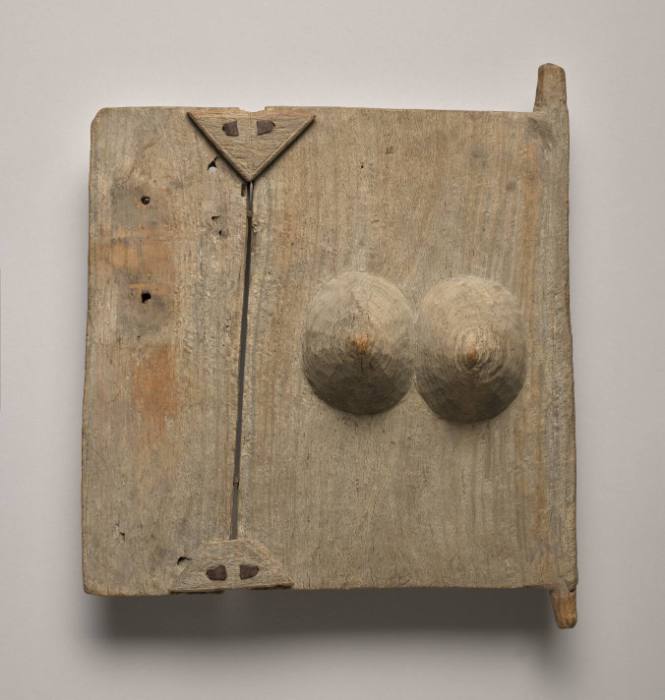

Granary Door
Artist
Dogon artist
DateEarly mid-20th century
MediumWood and iron
Dimensions19 1/4 x 16 3/4 in. (48.9 x 42.5 cm)
ClassificationsWood
Credit LineGift of Klaus and Joan Ries
Object number2016.21.1
On View
Not on viewThis small, weathered door or shutter would have probably sat high on a free-standing granary building made of puddled earth and topped with a thatched-covered roof. Its posts act as hinges and were inserted into matching holes bored into the granary's doorframe. Doors of such structures were secured with a bolt lock that was affixed to the door, evidence of its placement is visible in the darkened area with holes on the door's proper right. It is thus opened and secured opposite to the current photo, which shows the door upside down.
ProvenanceCollected by Hans Ries (1907–1998), Mali, ca. 1961; exported to United States before 1969; to son, Klaus Ries, Southern Pines, NC; given to NCMA, 2016.
Exhibition HistoryRaleigh, NC, North Carolina Museum of Art, "The People's Collection, Reimagined," October 7, 2022–December 9, 2024. Object Rights Statement
The North Carolina Museum of Art (NCMA) makes images of its collection available online to support research and scholarship and to inform and educate the public. Certain works of art, as well as the photographs of those works of art, may be protected by copyright, trademark, or related interests not owned by the NCMA. The responsibility for ascertaining whether any such rights exist and for obtaining all other necessary permissions remains with the applicant. To request images and/or permissions from the NCMA, please complete our online request form.