
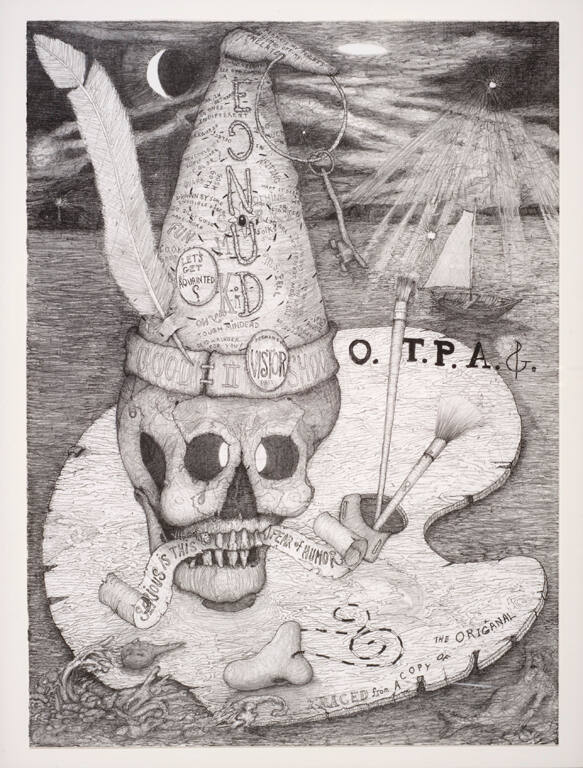
Spooky on the Line
Artist
William Wiley
American, 1937–2021
Date1980
MediumLithograph on paper
Dimensions30 x 22 in. (76.2 x 55.9 cm)
ClassificationsPrints
Credit LineGift of Mary and Jim Patton
Object number2014.20.81
On View
Not on view[J. Dasal, 2014]ProvenanceCreated California, 1980; collection of the artist. Mary and James R. Patton Jr., Great Falls, VA; given to NCMA, 2014.
Published ReferencesJoann Moser, John Yau, andJohn G. Hanhardt, What’s It All Mean: William T. Wiley in Retrospect ( Berkeley, Los Angeles, and London: University of California Press,2009), illus. 158.
Exhibition HistoryRaleigh, NC, North Carolina Museum of Art, “The Patton Collection: A Gift to North Carolina,” March 28–August 23, 2015. Object Rights Statement
The North Carolina Museum of Art (NCMA) makes images of its collection available online to support research and scholarship and to inform and educate the public. Certain works of art, as well as the photographs of those works of art, may be protected by copyright, trademark, or related interests not owned by the NCMA. The responsibility for ascertaining whether any such rights exist and for obtaining all other necessary permissions remains with the applicant. To request images and/or permissions from the NCMA, please complete our online request form.



William Douglas MacLeod