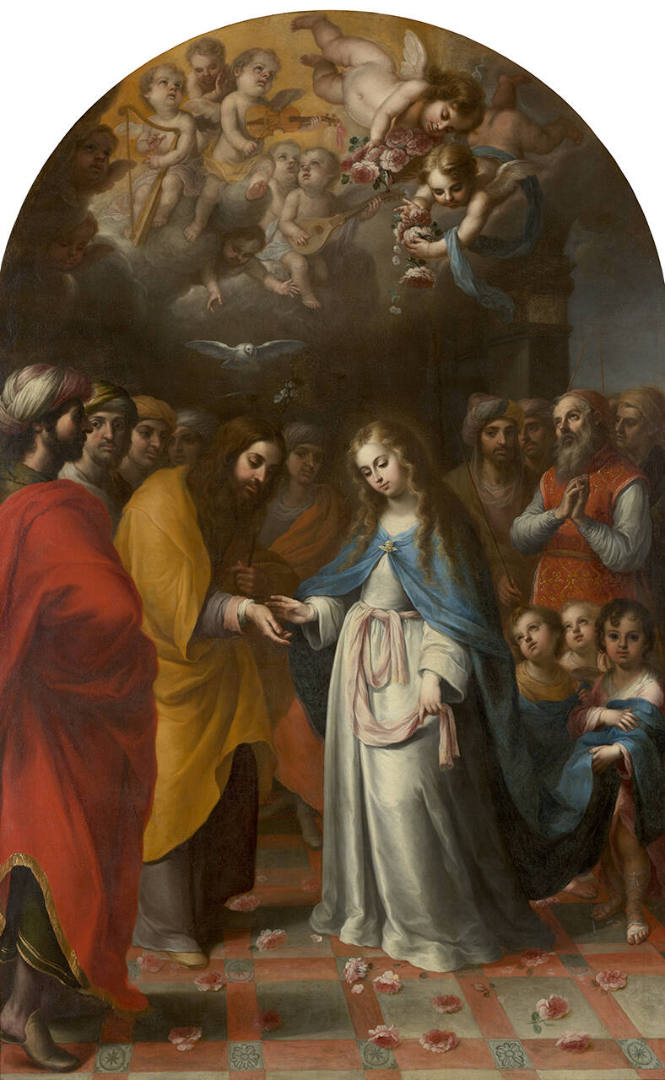
The Marriage of the Virgin
Artist
Esteban Márquez de Velasco
Spanish, died 1696
Datecirca 1693
MediumOil on canvas
Dimensions96 x 60 in. (243.8 x 152.4 cm)
Frame: 103 3/8 x 67 3/4 in. (262.6 x 172.1 cm)
Frame: 103 3/8 x 67 3/4 in. (262.6 x 172.1 cm)
ClassificationsPaintings
Credit LinePurchased with funds from the State of North Carolina
Object number52.9.180
On View
Not on viewSurrounded by turbaned men and wide-eyed children, the Virgin Mary and Joseph prepare to join hands in an age-old ceremonial gesture of marriage. The only mention in the Bible of the marriage of the Virgin Mary concerns her betrothal to Joseph (Luke 1:27). The story is told in considerable detail, however, in the thirteenth-century Golden Legend by Jacobus da Voragine, a compilation of stories of saints that was an important sourcebook for artists. According to these accounts, Mary was raised as a Temple maiden in Jerusalem. When she reached marriageable age, the high priest of the Temple was aided by a miraculous sign in selecting Joseph from among her many suitors. Each of them was instructed to bring the high priest a rod. While those of the other suitors remained bare, Joseph’s rod burst into bloom, and a dove miraculously appeared from heaven, as shown in this work by Márquez de Velasco. Demonstrating God’s blessing upon these events, the heavens open to reveal a choir of putti playing instruments and scattering pink roses upon the couple below. The rose is a traditional symbol of Mary as a pure, flawless virgin, or a “rose without thorns.” Indeed, a saintly radiance surrounds her head and her youthful, innocent face is without blemish.
The Marriage of the Virgin is probably one in a series of eight paintings showing scenes from the life of the Virgin Mary that Márquez de Velasco painted for the monastery of the Unshod Trinitarians in Seville. The paintings were removed from Spain during the Napoleonic Wars, and were sold and dispersed at auction in London in 1810ProvenanceClaustro de Trinitarios Descalzos, Seville, in 1780 [1]; William Hare (1801–1856), 2nd Earl Listowel, Ireland, as by Murillo, by 1854 [2]; by descent to his great-grandson, Rt. Hon. John Hare (1911–1982) [3]; 1st Viscount Blakenham, London; Sale, London, Christie’s, April 16, 1937, lot 49, as Murillo, sold for £52, sold to Leggett, London; Rt. Hon. Lord Brocket, Bramshill Park, Hants; Sale, London, Sotheby’s July 16, 1952, lot 79, as Murillo, sold to David Koetser, London; sold to NCMA, 1952.
[1] Antonio Ponz, Viage de España, en que se da noticia de las cosas mas apreciables, y dignas de saberse que hay en ella, 18 vols, Madrid, 1776-1794, vol. 9 (1780), Carta tercera, p. 105, [Seville], “46 Para ver á qué grado llegaron algunos discípulos de Murillo, conviene entrar en el claustro de Trinitarios Descalzos, en cuyos ángulos hay pinturas de Simon Gutierrez, y Esteban Marquez. Las del Christo muerto, y los Desposorios de nuestra Señora se tienen por del Mulatro. Es muy bella nuestra Señora con los Redentores á los pies. Hay diez y nueve retratos al rededor de este claustro hechos por los de la misma escuela. Algunas de estas pinturas se conoce estar [p. 106] retocades por Murillo. Tambien en el coro hay una nuestra Señora con Angeles, que tiene mérito.
[2] Gustav Waagen, Treasures of Art in Great Britain, London, 1854, vol. 2, p. 311, as Murillo, The Sposalizio. The painting may have been removed from the monastery during the Napoleonic Spanish campaigns when a number of paintings were taken from churches and monasteries throughout Spain and shipped to England.
[3] John Hare was the third son of the 4th Earl of Listowel.
Published ReferencesG. F. Waagen, Treasures of Art in Great Britain, Vol. 2 (1854), 311.
C. B. Curtiss, Velasquez and Murillo (London: 1883), no. 60.
W. R. Valentiner, Catalogue of Paintings: Including Three Sets of Tapestries (Raleigh: North Carolina Museum of Art, 1956), no. 212, illus. (b-w).
Juan Antonio Gaya Nuño, La pintura español fuera de españa (Madrid: 1958), cat. no. 1844.
Diego Ángulo Iñiguez, Murillo, su vida, su arte, su obra, Vol. 2 (Madrid: 1981), 345-46.
Diego Ángulo Iñiguez, "Varias obras de Esteban Marquez atribuidas a Murillo," Goya, no. 169-71 (July-December 1982), 3-6, illus. 4.
Edward J. Sullivan, Catalogue of Spanish Paintings (Raleigh: North Carolina Museum of Art, 1986), cat. no. 14, illus. (b-w) 47, also mentioned x.
Enrique Valdivieso, Historia de la Pintura Sevillana, Siglos XIII al XX (Sevilla: FOCUS, 1986), 246, illus. (color) 247.
Introduction to the Collections. rev. ed. (Raleigh: North Carolina Museum of Art, 1992), illus. (b-w) 212.
Rebecca Martin Nagy, entry for The Marriage of the Virgin, in North Carolina Museum of Art: Handbook of the Collections, Rebecca Martin Nagy, ed. (Raleigh: North Carolina Museum of Art, 1998), 154, illus. (color), detail (color) 155.
Jonathan Brown, Painting in Spain: 1500–1700 (New Haven: Yale University Press, 1998), mentioned and illus. (b-w) 232, fig. 303.
Enrique Valdivieso, "Murillo et la peinture de Séville: des prédécesseurs aux héritiers," in Dossier de L'Art, no 115 (January 2005), illus. (color) 51.
Rebecca Martin Nagy, entry for The Betrothal of the Virgin, in North Carolina Museum of Art: Handbook of the Collections, rev. ed. (Raleigh: North Carolina Museum of Art, 2010), 320, illus. (color) 321.
Adriana Cruz-Lara Silva, "Las atribuciones del ciclo pictórico de la vida de San Francisco del Museo Regional de Guadalajara en México" in Arte y Patrimonio en Iberoamerica (Castello de la Plana, Spain: Universitat Jaume I, 2016), illus. (color)Exhibition HistoryManchester, England, “Art Treasures,” 1857. Object Rights Statement
The North Carolina Museum of Art (NCMA) makes images of its collection available online to support research and scholarship and to inform and educate the public. Certain works of art, as well as the photographs of those works of art, may be protected by copyright, trademark, or related interests not owned by the NCMA. The responsibility for ascertaining whether any such rights exist and for obtaining all other necessary permissions remains with the applicant. To request images and/or permissions from the NCMA, please complete our online request form.

Juan de Borgoña
circa 1520–1540
Francisco de Zurbarán
circa 1650