Antinoüs
Artist
Paul Delvaux
Belgian, 1897–1994
Date1958
MediumOil on plywood
Dimensions49 1/8 x 75 1/8 in. (124.8 x 190.8 cm)
Frame: 50 3/8 x 76 3/8 x 1 1/2 in. (128 x 194 x 3.8 cm)
Frame: 50 3/8 x 76 3/8 x 1 1/2 in. (128 x 194 x 3.8 cm)
ClassificationsPaintings
Credit LineGift of John L. Loeb
Object numberG.62.22.3
On View
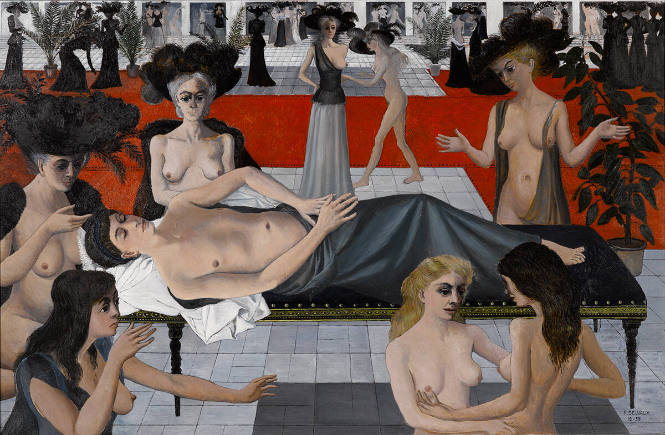
On viewPaul Delvaux was nearly forty when he discovered the Italian Surrealist Giorgio de Chirico, whose work was to have decisive impact on his style. Though Delvaux never officially joined their ranks, both he and the Surrealists relied on the unconscious as a source of revelation. As a result his paintings, like theirs, are haunted by enigmas. Delvaux’s statuesque females—unfazed by their public nudity and largely indifferent to one another—occupy phantasmal settings. The artist’s themes, shaped by incongruity and contradiction, often relate to the impenetrable isolation in which each individual dwells.
Delvaux acknowledges Marguerite Yourcenar’s 1954 novel, Memoires d’Hadrien, as the inspiration for his painting. In this vivid reconstruction of the Roman emperor’s life, Yourcenar has Hadrian musing on the nebulous borders between real-life experiences and dreams and on the inability of reason to explain matters of the heart—ideas with ready appeal for Delvaux. The artist then ignores the details of the ruler’s infatuation with the exotic, ill-fated Antinoüs, who drowned in the Nile. Instead he confronts viewers with a sad and strange deathbed ritual. Only three figures pay Antinoüs any heed. The rest of the solemn celebrants—all women, many in extravagant hats, some scantily clad—Delvaux arranges frieze-like in the background and middle ground. The entire cult has been transported beyond the rational to a dream world of inexplicable mysteries.
ProvenanceMme. Lithiby, Paris; M. Knoedler and Co., New York; John L. Loeb, New York; given to NCMA, 1962Published References"Acquisitions," North Carolina Museum of Art Bulletin 4, nos. 2 and 3 (Winter-Spring 1964), listed 58.
Paul-Aloïse De Bock, Paul Delvaux (Brussels: Laconti: 1967), 298, listed 298, no. 130, illus. (b-w) pl. 130.
Michel Butor, et al, Delvaux (Lausanne: La Bibliothèque des Arts, 1975), discussed and illus. (b-w) 92, listed and illus. (b-w) no. 242.
Edgar Peters Bowron, ed., Introduction to the Collections (Chapel Hill: published for the North Carolina Museum of Art, Raleigh, by The University of North Carolina Press, 1983), illus. (b-w) 276.
Barbara Emerson, Delvaux (Antwerp: Fonds Mercator, 1985), discussed 151, illus. (color).
Sasha M. Newman, "'Stages of Sentimental Life': The Nudes and the Interiors," in Félix Valloton (New Haven: Yale University Art Gallery, 1991), 123-167, noted 130, illus. (b-w) fig. 154.
Introduction to the Collections, rev. ed. (Raleigh: North Carolina Museum of Art, 1992), illus. (b-w) 274.
Huston Paschal, entry for Antinoüs, in North Carolina Museum of Art: Handbook of the Collections, Rebecca Martin Nagy, ed. (Raleigh: North Carolina Museum of Art, 1998), 229, illus. (color).
Huston Paschal, entry for Antinoüs, in North Carolina Museum of Art: Handbook of the Collections, rev. ed. (Raleigh: North Carolina Museum of Art, 2010), 482, illus. (color) 483.
Exhibition HistoryAntwerp, Belgium, Meir, Salle des fêtes, "L'Art contemporain. Salon 1959," August 1-23, 1959, no. 95.
Colorado Springs, CO, Colorado Springs Fine Arts Center, "New Accessions USA," June 15-September 13, 1964, no. 37, illus. (b-w).
Raleigh, NC, North Carolina Museum of Art, "“a little offbeat, a little dreamy, and mysterious,” November 15, 2023-present.
Object Rights Statement
The North Carolina Museum of Art (NCMA) makes images of its collection available online to support research and scholarship and to inform and educate the public. Certain works of art, as well as the photographs of those works of art, may be protected by copyright, trademark, or related interests not owned by the NCMA. The responsibility for ascertaining whether any such rights exist and for obtaining all other necessary permissions remains with the applicant. To request images and/or permissions from the NCMA, please complete our online request form.

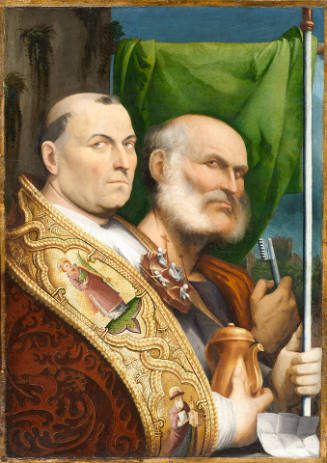
Giovanni Antonio da Pordenone
circa 1515–1517
Paul Hampden Dougherty