

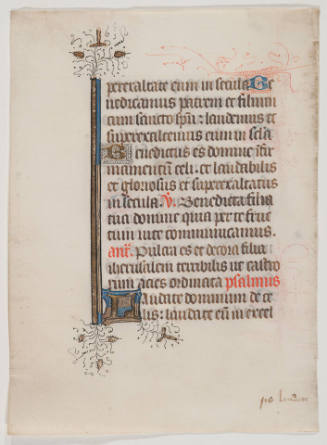
Manuscript illumination in an initial A from an antiphonal: Two Marys at the Tomb
Artist
Circle of Bergognone (Ambrogio da Fossano)
Italian, 1453–1523
Datecirca 1495–1505
MediumTempera, ink, and gold on parchment
DimensionsMax H. 10 3/8 in. (26.4 cm) x Max W. 8 3/4 in. (22.2 cm) [work is not square]
ClassificationsBook Arts
Credit LineGift of J. B. Neumann in memory of W. R. Valentiner
Object numberG.59.20.2
On View
On viewIn accordance with Matthew’s full account of the Resurrection, we see “Mary Magdalen and the other Mary” approaching Christ’s tomb when an angel suddenly appears, “his countenance … as lightning, and his raiment as snow.” “Fear not you,” he tells them, “for [Jesus] is risen.” The artist captured the angel’s dazzling brightness by cladding him in a luxurious white robe and star-speckled blue and green cape fastened with a jeweled clasp.
[L. Humphrey, “The People’s Collection, Reimagined,” 2026]
Published References"Catalogue of Early Book Art," North Carolina Museum of Art Calendar of Art Events (May 1962), cat. no. 4.Exhibition HistoryRaleigh, NC, North Carolina Museum of Art, "Early Book Art," May 1962, then traveling, cat. no. 4.
Raleigh, NC, North Carolina Museum of Art, “Reflections on Light: Works from the NCMA Collection,” [Part 1] September 9, 2020–April 4, 2021.
Raleigh, NC, North Carolina Museum of Art, "The People's Collection Reimagined," May 19, 2026-present.
Object Rights Statement
The North Carolina Museum of Art (NCMA) makes images of its collection available online to support research and scholarship and to inform and educate the public. Certain works of art, as well as the photographs of those works of art, may be protected by copyright, trademark, or related interests not owned by the NCMA. The responsibility for ascertaining whether any such rights exist and for obtaining all other necessary permissions remains with the applicant. To request images and/or permissions from the NCMA, please complete our online request form.
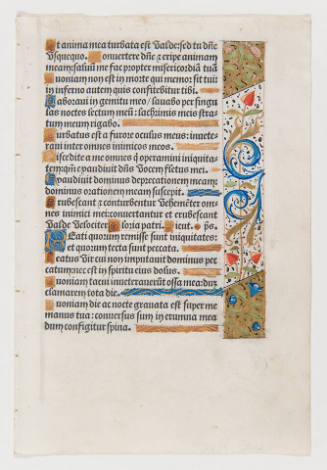
![Leaf from a missal (use unknown) with the mass for the vigil of Saint Andrew the apostle and commemorations of saints Saturninus, Chrysanthus, Maurus, and Daria (November 29) [Sanctorale, p. clxxi]
Imprint: Printed in Basel circa 1470–80](/internal/media/dispatcher/17603/thumbnail)

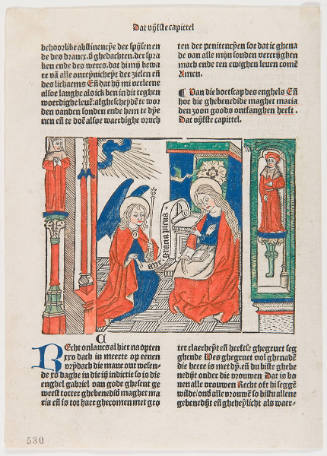

![Leaf from a book of hours: from the Hours of the Passion according to John (John 19:28–32) [foliated ‘20’]](/internal/media/dispatcher/17601/thumbnail)
Master of Étienne Poncher
circa 1490–1500

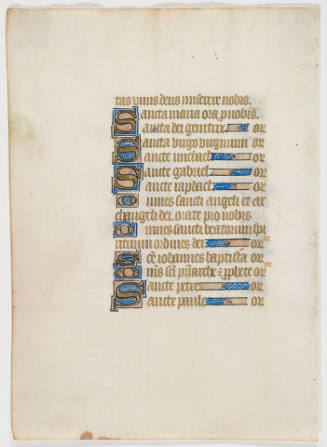
Unknown scribe
circa 1250