
The Crucified Christ
ArtistCircle of
Hans Memling
German, South Netherlandish, circa 1430/1440–1494
Datecirca 1480
MediumOil on oak panel
Dimensions17 3/4 x 11 in. (45.1 x 27.9 cm)
Frame: 21 3/16 x 15 1/2 x 2 1/4 in. (53.8 x 39.4 x 5.7 cm)
Frame: 21 3/16 x 15 1/2 x 2 1/4 in. (53.8 x 39.4 x 5.7 cm)
ClassificationsPaintings
Credit LinePurchased with funds from the State of North Carolina
Object number52.9.102
On View
On viewThe two heraldic shields incorporated into the composition indicate it passed from a Netherlandish owner to a Venetian one before 1491. The image of a donor that may date to the original owner appeared to the right of the cross but was painted over. Venice and Bruges had close mercantile connections in the late fifteenth century, and Memling’s paintings and those of his contemporaries were prized by Venetian collectors.
[L. Humphrey, "The People's Collection, Reimagined," 2022]ProvenanceCreated in the Burgundian Netherlands about 1480 [1]; a member of the Glymes family, possibly Jan II “Metten Lippen” van Glymes (van Bergen) (1417–94), lord of Bergen op-Zoom, Duchy of Brabant, Burgundian Netherlands [2]; possibly Cardinal Marco Barbo (1420–1491), Venice and Rome [3]. Giovanni Albarelli (1765–1821), Verona, Italy, by 1815 [4]; passed through the Reale Accademia delle Belle Arti in Venezia, sometime between 1815 and 1866 [5]. Baron Arthur de Schickler (1828–1919), Paris and Château de Martinvast, Normandy, France [6]; by inheritance to Countess Hubert de Pourtalès (1870-1956), née Marguerite de Schickler [7]; [purchased from Hubert de Pourtalès, Paris by Edward Fowles (1885–1971), December 30, 1937, who sold ⅓ shares each to Hans Wendland and Armand Lowengard, until July 20, 1949] [8]; [Hans Wendland (1880-ca. 1965), July 20, 1949 until ca. 1951] [9]; [E. and A. Silberman, New York, by 1951] [10]; sold to NCMA on February 19, 1952.
[1] According to Peter Klein’s dendrochronological analysis dated April 13, 1993: “Regarding the sapwood statistic of Eastern Europe, the earliest felling date can be derived for the year 1463, more probable is a felling date between 1467…1469…1473 + X. With a minimum of two years for seasoning, the earliest creation of the painting is possible from 1465 upwards. Under the assumption of a median of [illegible] sap rings and 10 years storage time, as usual in the 15[th] century, a creation is plausible from 1479 upwards.” Klein subsequently identified a panel with the Virgin and Child (private collection) by a follower of Memling cut from the same tree; see Klein 1997, 290–291. Tomasz Wazny reached similar conclusions in his October 24, 2013 dendrochronological examination of the painting.
[2] In a letter to Justus Bier dated January 20, 1976, Hans Joachim-Eberhardt identified the lower coat of arms as that of the House of Glymes. Notably, a description of the painting in Giovanni Albarelli’s 1815 inventory describes it as “commissioned by the archbishop of Flanders, whose arms appear below the cross”. This could point to Henri de Berghes (Glymes), bishop of Cambrai from 1480 until his death in 1503. There was no single “archbishop of Flanders,” as the region was divided among several dioceses, primarily under the Diocese of Cambrai. Other members of the Glymes family are Jan III van Glymes and Henri’s father, Jan II van Glymes van Bergen (1417–94).
It is unknown when the coats of arms were added. Both manifest the same craquelure pattern as the surrounding paint and appear to have been painted at the same time by the same hand. On the Van Glymes, see Diana K. Withee, “Some Additions to Bosch’s Circle of Noble Patrons ,” In Jheronimus Bosch: His Patrons and His Public (3rd International Jheronimus Bosch Conference September 16-18, 2012) ('s Hertogenbosch: Jheronimus Bosch Art Center, 2014), 1–39.
[3] Ferber 1966, 17–20 identified the upper coat of arms as those of Pietro Barbo, elevated to cardinal in 1441 and elected pope in 1464 (Paolo II). As Hannegan 198–1981 pointed out, this would put the painting’s execution before Pietro’s election as pope (since the arms feature a cardinal’s hat rather than a tiara), which is impossible given the dendrochronological date of the panel. Hannegan therefore argued that the arms more likely refer to Pietro’s nephew Marco Barbo (ca. 1420–1491), who was himself elevated to cardinal in 1467. According to Ferber, 20n6, the inventories of the Barbo estates compiled by the Venetian State after the family line was extinguished (1721) list four small panels (picioli quadri) that could possibly refer to the NCMA painting (citing Archivio di Stato, Venice, b. 415, n.29; b. 418, n.9; b. 422, n.24).
[4] As noted by Hans Joachim-Eberhardt in a letter to Justus Bier dated January 20, 1976, this painting is recorded in three inventories of the Giovanni Albarelli collection in Verona made between 1815 and 1818 (as by Lucas van Leyden), including the 1815 inventory that includes a drawing of the painting by Giovanni’s nephew Paolo Cagliari (1763–1835). See Caliari 1815, ed. Dal Forno 1975. In the latter the painting is described as commissioned by the “archbishop of Flanders, whose arms appear beneath the cross.” See also Succinta descrizione 1816.
On the Albarelli collection, see Loredana Olivato, “Per il mercato dell’arte a Verona all'inizio del secolo XIX: Il caso Albarelli” in Tra committenza e collezionismo: studi sul mercato dell’arte…, ed. Enrico Maria Dal Pozzolo and Leonida Tedaldi (Vicenza: Terra Farma, 2003), 167–176. On the back of the painting is a wax seal decorated with a double-headed eagle with crown and inscription: “( )ED D(E)L TRIB PROV IN V(ER) ONA”.
[5] One of the two red wax seals on the back side of the panels, inscribed “REAL[E] / ACCADEMIA / DELLE / [B]EL[LE] ARTI / IN VENEZIA” places the painting at the Venetian Accademia between 1815 and 1866, when the Kingdom of Lombardy-Venetia was a constituent kingdom of the Austrian Empire ruled by the Habsburg emperor in his capacity as king.
[6] According to the dealer’s information sheet, the panel was formerly in the collection of Baron Schickler, in Paris. This is affirmed by letters from Edward Fowles, Duveen Brothers, New York, to the Paris and London offices of Duveen Brothers in which he states the painting “came from Pourtalès.”
[7] Arthur’s collection passed by inheritance to his daughter Comtesse Hubert de Pourtalès (1870–1956), née Marguerite de Schickler. Marguerite, who married Comte Hubert de Pourtalès in 1890, was her father’s sole heir. Although Duveen Brothers acquired portions of the Schickler-Pourtalès collection beginning in 1919, the business never acquired the present panel. It is not mentioned in the Schickler fond among the Duveen Brothers Records, 1876-1981, bulk 1909-1964, The Getty Research Institute, Los Angeles, Accession no. 960015, http://hdl.handle.net/10020/cifa960015, series II.A., Files Regarding Works of Art, Peggy Schickler Collection: Paintings, Drawings, Marbles, ca. 1916–1954.
[8] According to a letter, dated February 12, 1949, from Edward Fowles, Duveen Brothers, New York to his London attorney, Fowles purchased the painting on December 30, 1937. According to Fowles’s correspondence with Duveen Brothers, Paris and Duveen Brothers, London, Fowles obtained authentications from Max Friedländer in 1937–1938, and 1948. See Duveen Brothers records, 1876–1981 (bulk 1909–1964), series II.G. Edward Fowles papers, Edward Fowles correspondence regarding works of art, [1948] 1949–1951.
Furthermore, Friedländer retained a photograph of the painting and recorded his certifications to “Duveen” (that is, Fowles) in handwritten notes on the reverse of the painting, for which see the Friedländer RKD project. Inscriptions include: “Duveen / VI. 37' en 'Duveen / VI. 38 / gereinigt / Exp.[ertise]”; “Duveen / 1948 / Guta.[chten]”.
Fowles, still living in Paris in 1937, lent the painting to the 1939 Memling exhibition in Bruges. Because war was breaking out when the exhibition closed in October 1939, the painting was not returned to Fowles in Paris but to the London office of Duveen Brothers for safekeeping. Fowles purchased Armand Lowengard’s ⅓ share from Lowengard’s heirs on June 24, 1947. In 1948, Fowles began corresponding with the Paris and London offices to request that the painting be sent to him in New York along with all of his correspondence with Friedländer. After successfully applying for an export license through his London attorney, Fowles had the painting sent to New York. On May 6, 1949, he consigned the painting to Duveen Brothers, New York, as stock number C.12741; see Duveen Brothers records, series I.D., General business records, Stock ledger, ca. 1947–1951, p. 76, no. 12741: “Framed painting Christ on Cross by Memling”. A small sticker on the back of the painting records this number and Fowles’s initials “E. F.”
[9] On July 20, 1949, Hans Wendland sent a payment to Fowles in New York for his two third shares ($2,000 per share) and instructed him to deliver the painting to Keating, Customs Brokers, 90 Broad Street, New York, NY, “on behalf of R. Goetz”, which Fowles did on July 20, 1949. See Duveen Brothers records, series II.G., Edward Fowles papers, Edward Fowles correspondence regarding works of art, [1948] 1949–1951: letters of July 13, 1949 from Marcel Jonas, Duveen Brothers, Paris to Edward Fowles,
Duveen Brothers, New York; July 20, 1949 from Fowles to Jonas; July 16, 1949 from Wendland to Fowles, July 13, 1949 from Jonas to Fowles; July 11, 1949 from Duveen Brothers, Paris to Fowles, Duveen Brothers, New York.
[10] Mrs. Paul Moore, Chairman of Art, The Society of Four Arts, Palm Beach, undated transcription of a letter to E. &. A. Silberman Galleries, expressing gratitude for loan of Memling to their exhibition. The dealer’s data sheet on the painting cites Friedländer’s opinion that the painting was by Memling.Published ReferencesPaolo Caliari, “Luca d’Olanda,” in “Gabinetto di quadri o raccolta di pezzi originali esistenti in Verona presso il signor Gio. Albarelli disegnatti [sic] da Paolo Calliari [sic] con illustrazioni”, 1815, Biblioteca Civico, Verona, ms. 1847; facsimile ed. Federico dal Forno, La Pinacoteca Albarelli (Verona: Stamperia della Cassa di Risparmio di Verona Vicenza e Belluno, 1975) (as Lucas van Leyden).
Succinta descrizione d’una raccolta di quadri originali, esistenti in Verona presso il signor Giovanni Albarelli (Verona: Tipografia Mainardi, 1816).
Succinta descrizione d’una raccolta di quadri originali, esistenti in Verona presso il Sig. Giovanni Albarelli, 2nd ed. (Verona: Società Tipografica, 1818), 6, no. VIII.
Memling Exhibition: Organized by the Municipality in the Art Gallery of Bruges(June 22 to October 1, 1939) (Bruges: Desclée, De Brouwer et Cie, 1939), 67, cat. no. 16.
Portraits, Figures and Landscapes: Jan. 12–Feb. 4, 1951, The Society of the Four Arts, Palm Beach (Palm Beach: The Society of the Four Arts, 1951), cat. no. 28.
“State Getting Top-Flight Art Collection,” News and Observer, November 28, 1954, 52, illus.
W. R. Valentiner, Catalogue of Paintings: Including Three Sets of Tapestries (Raleigh: North Carolina Museum of Art, 1956), 64, cat. no. 121 (as ex-colls Baron Schickler, Paris; private collection, England).
Charles W. Stanford, “Easter,” North Carolina Museum of Art Calendar of Art Events 3, no. 7 (April 1960), discussed and illus. (b-w).
Stanley Ferber, “The Armorial Device in Memling’s Christ on the Cross,” North Carolina Museum of Art Bulletin 6, nos. 2–3 (Winter–Spring 1966), 17–20, illus. (b-w) 16, detail (b-w) 17.
Exhibition Number One from the Permanent Collection (exhibition catalogue) (Raleigh: North Carolina Museum of Art, 1970), 20, illus. (color) 21 (as Hans Memling).
Max J. Friedländer, Early Netherlandish Painting, vol. 6, part 2, Hans Memlinc and Gerard David, rev. ed., trans. Heinz Norden (New York: Praeger Publishers, 1967), 114, add. 274, pl. 255 (as Master of the Legend of St. Ursula).
Barry Hannegan, unpublished entry prepared for proposed Dutch and Flemish catalogue, NCMA, May 1980–December 1981.
Edgar Peters Bowron, ed., Introduction to the Collections (Chapel Hill: University of North Carolina Press for the North Carolina Museum of Art, 1983), 128 (as Hans Memling).
Introduction to the Collections, 2nd rev. ed. (Raleigh: North Carolina Museum of Art, 1992), illus. (b-w) 108.
Peter Klein, “Dendrochronological Analyses of Panels of Hans Memling and His Contemporaries,” in Memling Studies: Proceedings of the International Colloquium (Bruges, 10–12 November 1994), ed. Hélène Verougstraete, Roger van Schoute, and Maurits Smeyers, with the collaboration of Anne Dubois (Leuven: Uitgeverij Peeters, 1997), 287–295 at 290–291.
Vida J. Hull, “Spiritual Pilgrimage in the Paintings of Hans Memling,” in Art and Architecture of Late Medieval Pilgrimage in Northern Europe and the British Isles, eds. Sarah Blick and Rita Tekippe (Leiden: Brill, 2004), 29–50, at 47–48, 47n52–53, fig. 20.
“RKD Images,” Friedländer Project, RKD Research, Nederlands Instituut voor Kunstgeschiedenis, accessed 7/29/26, https://rkd.nl/images/116945 (as Meester van de Legende van de Heilige Ursula [Brugse], Christus aan het kruis, laatste kwart 15de eeuw, paneel [hout], olieverf, 45.1 x 27.9 cm).
“RKDtechnical,” Dendrochronologie Project, RKD Research, Nederlands Instituut voor Kunstgeschiedenis, accessed 7/29/26, citing Peter Klein reports dated 1986-09-14 and 1993-04-13, https://rkd.nl/technical/5005147.Exhibition HistoryBruges, Groeningemuseum, “Memling Exhibition: Organized by the Municipality in the Art Gallery of Bruges,” June 22 to October 1, 1939, cat. no. 16 (lent by Edward Fowles, Paris, listed in catalog as private property).
Palm Beach, FL, The Society of the Four Arts, “Portraits, Figures and Landscapes,” Jan. 12-Feb. 4, 1951, cat. no. 28 (lent by Silberman).
Raleigh, NC, North Carolina Museum of Art, “Exhibition Number One from the Permanent Collection,” October 1970.
Object Rights Statement
The North Carolina Museum of Art (NCMA) makes images of its collection available online to support research and scholarship and to inform and educate the public. Certain works of art, as well as the photographs of those works of art, may be protected by copyright, trademark, or related interests not owned by the NCMA. The responsibility for ascertaining whether any such rights exist and for obtaining all other necessary permissions remains with the applicant. To request images and/or permissions from the NCMA, please complete our online request form.
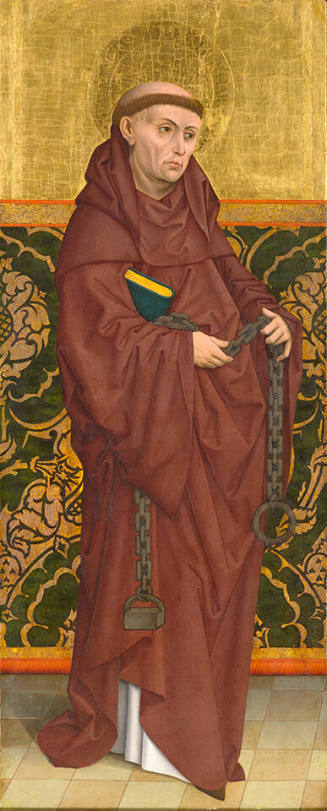
Hans Pleydenwurff
circa 1464