
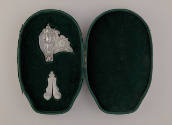
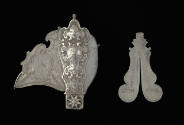


Circumcision Knife and Shield with Case
Artist
Alessandro Doria
Italian, Rome, 1680–1767, active in Rome 1736–1767
DateKnife: 1751–1761, per mark; Shield: probably last half of 18th century
MediumKnife: silver: repoussé, embossed, engraved; steel
Shield: silver: engraved
Case: wood structure; leather tooled and gilded; paper, metal hardware; velvet textile (modern)
Dimensionsheight, width, and depth (Knife [open]): 6 5/8 × 3 1/4 × 1/2 in. (16.8 × 8.3 × 1.3 cm)
height, width, and depth (Knife [closed]): 4 × 3 5/8 × 1/2 in. (10.2 × 9.2 × 1.3 cm)
height, width, and depth (Shield): 2 7/8 × 1 7/8 × 1/16 in. (7.3 × 4.8 × 0.2 cm)
height, width, and depth (Case): 2 1/8 × 11 1/8 × 7 1/4 in. (5.4 × 28.3 × 18.4 cm)
height, width, and depth (Knife [closed]): 4 × 3 5/8 × 1/2 in. (10.2 × 9.2 × 1.3 cm)
height, width, and depth (Shield): 2 7/8 × 1 7/8 × 1/16 in. (7.3 × 4.8 × 0.2 cm)
height, width, and depth (Case): 2 1/8 × 11 1/8 × 7 1/4 in. (5.4 × 28.3 × 18.4 cm)
ClassificationsMetal
Credit LineGift of Lisa and Steven Feierstein in honor of their grandsons Ethan and Theodore, and all future grandchildren and generations
Object number2021.8/1-3
On View
On viewMost circumcision knives are practical and undecorated. This knife—bearing a Modigliani family crest—is beautifully crafted by a highly artistic, skilled silversmith. Extensive Hebrew texts on both sides of the knife and shield cite biblical verses and liturgy with multiple references to the prophet Elijah, traditionally believed to attend circumcision ceremonies and to be a symbol of the upcoming dawn of the messianic era.
ProvenanceCreated Italy, 1751–1761 (knife) and last half of 18th century (shield); unidentified individual; Rabbi Avraham ben Eliezer Modigliani, (per inscription); probably by descent in Modigliani family, Livorno, Italy; a mohel of the Ventura family, Livorno; Prof. Augusto Cassouto, Rome; Pacifici family, Jerusalem; [art market, Israel]; [Antichità Alberto di Castro, Rome, ca. 2020]; sold to NCMA, 2021.Published ReferencesAnna Bulgari Calissoni, Maestri Argentieri Gemmari e Orafi di Roma (Rome: Fratelli Palombi Editori, 1987).Exhibition HistoryMaastricht, The Netherlands, “TEFAF Online,” October 30-November 4, 2020.
Raleigh, NC, North Carolina Museum of Art, "The People's Collection, Reimagined," October 7, 2022–present. Object Rights Statement
The North Carolina Museum of Art (NCMA) makes images of its collection available online to support research and scholarship and to inform and educate the public. Certain works of art, as well as the photographs of those works of art, may be protected by copyright, trademark, or related interests not owned by the NCMA. The responsibility for ascertaining whether any such rights exist and for obtaining all other necessary permissions remains with the applicant. To request images and/or permissions from the NCMA, please complete our online request form.
Unidentified workshop, associated with Hoaching
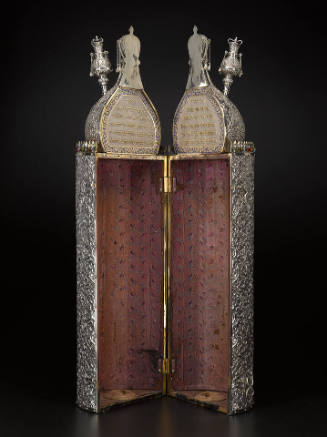
Case: circa 1860 or earlier; finials and pointer: probably later
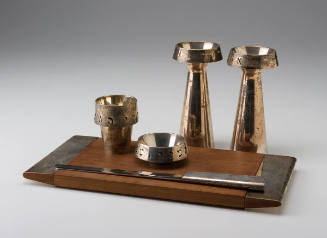
Moshe Zabari
designed 1963