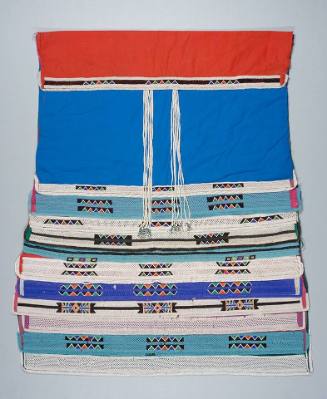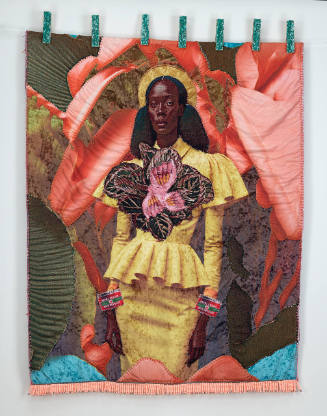


Wedding Day Cape (Isikoti)
Artist
Artist Unknown
Date1960s
MediumCloth, glass beads, yarn, brass buttons
Dimensions35 x 29 in. (88.9 x 73.7 cm)
ClassificationsTextiles
Credit LinePurchased with funds from Kenneth and Ellen Chance
Object number2001.8
On View
Not on viewThis exquisitely beaded wedding cape belonged to Mrs. Kafogo Mazibuko (b. 1945) of Euculwane, South Africa. It was assembled in the 1960s prior to her marriage from strips given to her female family members and in-laws. Each strip was hand-beaded and references a personal history or statement. Through such personal narratives, women are able to remind the young bride of her familial connections and responsibilities, while expressing hopes and dreams for her in her new life. Note the iconography of couples and houses to relate such well wishes. Additionally, specific colors and patterns would be legible only by women versed in specific beading techniques and histories.
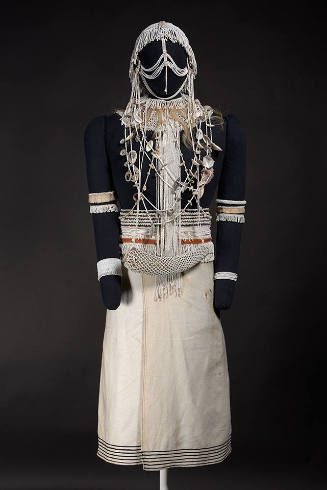
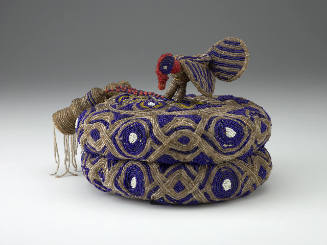
Similarly, this flared headdress (isicholo) was historically reserved for married women and signified her status. Based on a conical hairstyle that married Zulu women wore in the late nineteenth and early twentieth century, it has today been adopted as part of traditional Zulu dress ensembles worn exclusively at ceremonial events and special occasions. Such hats past and present are rubbed with red ocher and fat as a symbol of prosperity, but ochre is also used as a natural sunscreen and skin treatment, associating it with feminine beauty. It has thus become one of the most popular and identifiable symbols of Zulu womanhood.
[Rotation, installed 2019, with 2017.20.15, A. Maples]ProvenanceMade in 1960s for Kafogo Mazibuko, Euculwane, South Africa; purchased by Frank Jolles, South Africa, 1996; sold to NCMA 2001.
Published ReferencesMary Ellen Soles, "Accent on Africa: Recent Acquisitions of African Art," Preview: The Magazine of the North Carolina Museum of Art (March/April 2003), briefly discussed and illus. (color) 9.
Exhibition HistoryRaleigh, NC, North Carolina Museum of Art, "Accent on Africa: Recent Acquisitions of African Art," April 6-August 10, 2003, brochure no. 9, illus. (b-w).
Raleigh, NC, North Carolina Museum of Art, "The People's Collection, Reimagined," December 9, 2024-October 20, 2025.
Object Rights Statement
The North Carolina Museum of Art (NCMA) makes images of its collection available online to support research and scholarship and to inform and educate the public. Certain works of art, as well as the photographs of those works of art, may be protected by copyright, trademark, or related interests not owned by the NCMA. The responsibility for ascertaining whether any such rights exist and for obtaining all other necessary permissions remains with the applicant. To request images and/or permissions from the NCMA, please complete our online request form.