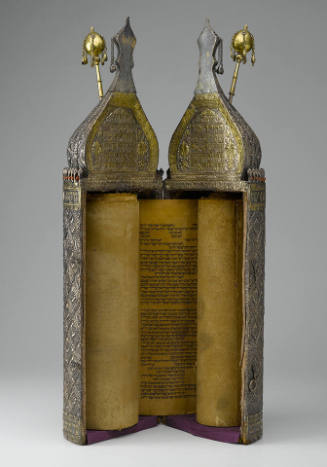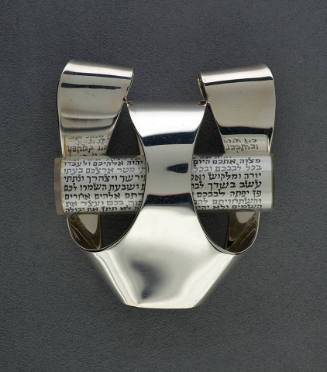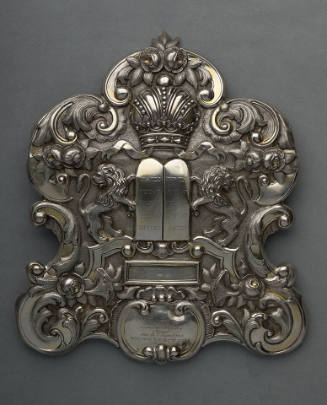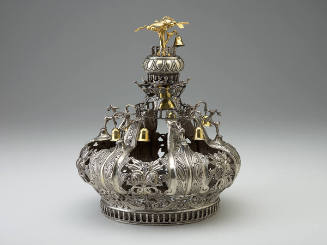
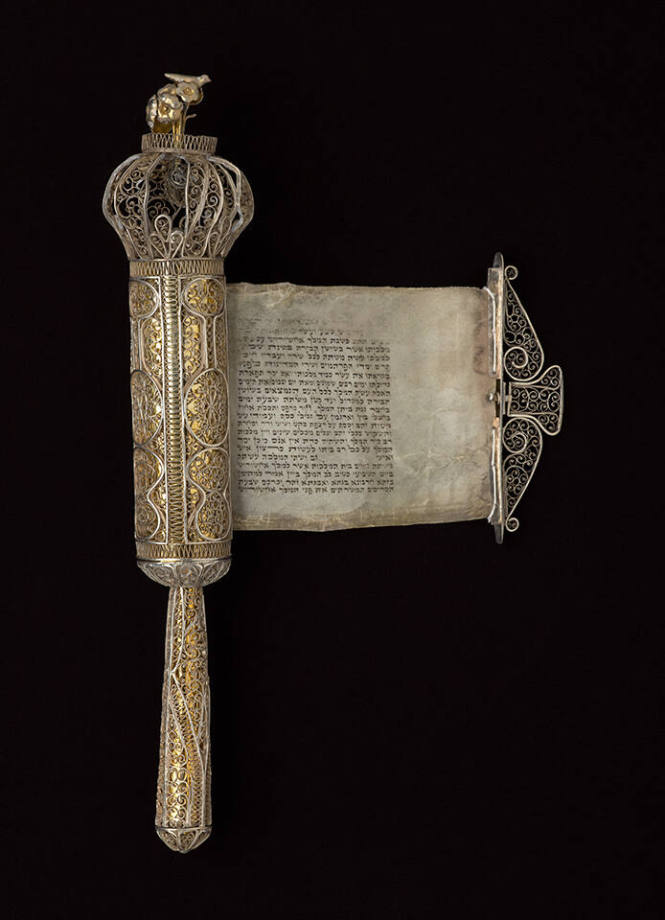
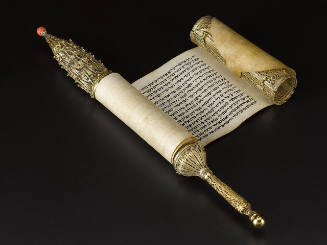
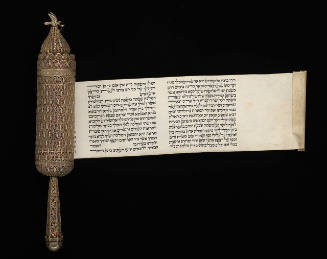
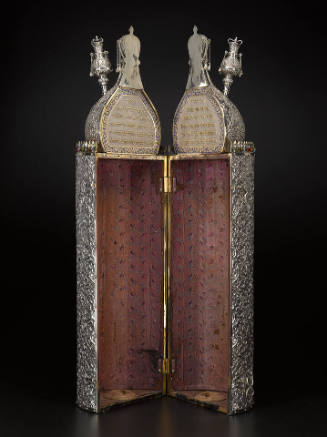
Esther Scroll and Case
Artist
Unknown
Date19th century
MediumCase: silver, partly gilded; scroll: ink on parchment
DimensionsH. 11 1/2 in. (29.2 cm)
ClassificationsMetal
Credit LineGift of Drs. Abram and Frances Pascher Kanof
Object numberG.78.3.2
On View
On viewPurim commemorates the rescue of the Jews of ancient Persia from the murderous plot of Haman, the king's advisor. The plot is foiled by Queen Esther, who reveals Haman's treachery to King Ahasuerus (Xerxes), the moment dramatized by painter Jan Lievens in The Feast of Esther, also in the Museum's collection. Purim is celebrated in the synagogue by the reading of the Book of Esther, traditionally inscribed on a parchment scroll and kept in an ornamented case.ProvenanceCreated Galicia [present day Poland or Ukraine], 19th century. Drs. Abram and Frances Pascher Kanof, Raleigh, NC; given to NCMA, 1978.
Published ReferencesMark I. Pinsky, "Jewish Gems: North Carolina's unique collection of spiceboxes, seder plates and silver," The North Carolina Independent SPECTRUM (September 14-27, 1984), 17 (illus.).
L. E. [Lisa Eveleigh], "Private Collectors Share Their Art," North Carolina Museum of Art Preview (Autumn 1992), illus. (b-w) 14.
Abram Kanof, A Guide to the Judaic Art Collection of the North Carolina Museum of Art (Raleigh: North Carolina Museum of Art, 1996), cat. no. 32, pp. 18, 42-43, illus. 18, 42.
Exhibition HistoryRaleigh, NC, North Carolina Museum of Art, “Recent Acquisitions,” December 14, 1978-January 28, 1979.
Raleigh, NC, North Carolina Museum of Art, "The People's Collection, Reimagined," October 7, 2022–present. Object Rights Statement
The North Carolina Museum of Art (NCMA) makes images of its collection available online to support research and scholarship and to inform and educate the public. Certain works of art, as well as the photographs of those works of art, may be protected by copyright, trademark, or related interests not owned by the NCMA. The responsibility for ascertaining whether any such rights exist and for obtaining all other necessary permissions remains with the applicant. To request images and/or permissions from the NCMA, please complete our online request form.
Unidentified workshop, associated with Hoaching
Case: circa 1860 or earlier; finials and pointer: probably later

Alessandro Doria
Knife: 1751–1761, per mark; Shield: probably last half of 18th century