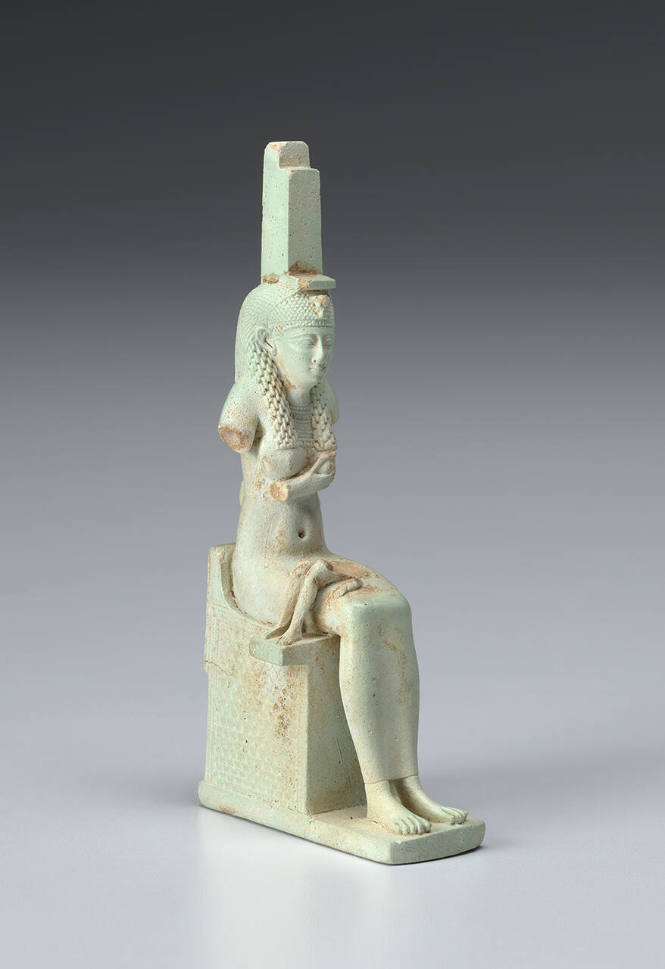
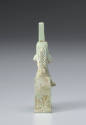
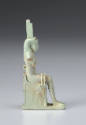
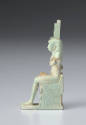
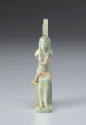
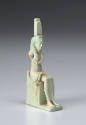
Amulet of Isis and Horus
Artist
Unknown Egyptian artist
Date305–30 BCE
MediumFaience
Dimensions6 1/4 x 1 5/8 x 3 in. (15.9 x 4.1 x 7.6 cm)
ClassificationsSculpture
Credit LinePurchased with funds from Arthur Leroy and Lila Fisher Caldwell, by exchange
Object number98.8
On View
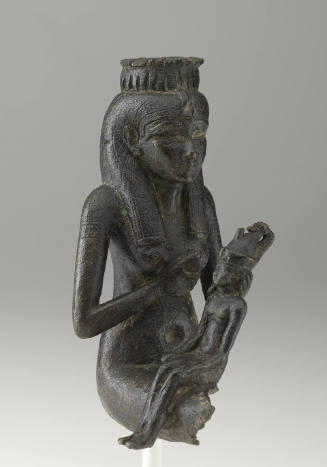
On viewAs the mother of Horus, Isis wears the vulture headdress that symbolizes motherhood. It is identified by the vulture's head on the brow, the wings tucked behind the ears, and the talons and tail at the back of the head. On top of the vulture crown, she wears the hieroglyphic symbol for "throne." This throne, similar to the exquisitely carved one upon which she sits, is also the hieroglyph of her name, Isis (which means "throne" or "seat"). Very little remains of the child Horus; only his legs and small hand survive on her lap.
Important throughout Egypt since the Old Kingdom, Isis is the ultimate mother goddess and protector of the dead thanks to her magical powers. Although she did not have temples until very late in Egyptian history, Isis was prominent in funerary rituals, and her amulets were favored by women and children. Isis is one of the few Egyptian deities whose cult spread outside of Egypt from the 4th century BCE onward.
At least eleven sanctuaries were dedicated to her in Greece and the Aegean Islands. Her cult was celebrated in the Kingdom of Kush (present-day Sudan) and in Italy—notably Rome and Pompeii.
[C. Rocheleau]ProvenancePrivate collection, Paris, France, mid-1960s; sold to Edward H. Merrin, New York, NY, early 1990s; sold to NCMA, 1998.
Published References"Art Acquisitions," North Carolina Museum of Art Annual Report (1998-99), mentioned 7.
Caroline M. Rocheleau, "Dusting Off the Years: The Thematic Reinstallation of the Egyptian Gallery," Preview: The Magazine of the North Carolina Museum of Art (March/April 2007), briefly discussed 12-13, illus. (color) 12.
Caroline M. Rocheleau, entry for Amulet of Isis and Horus, in North Carolina Museum of Art: Handbook of the Collections, rev. ed. (Raleigh: North Carolina Museum of Art, 2010), 38, illus. (color) 39.
Caroline M. Rocheleau, Ancient Egyptian Art [Systematic Catalogue of the Collection] (Raleigh, NC: North Carolina Museum of Art, 2012), cat. no. 29, illus. (color) 81 and 82.
North Carolina Museum of Art, "The People's Collection," (Raleigh, NC; North Carolina Museum of Art, 2024), illus. (color) 177.
Exhibition HistoryRaleigh, NC, North Carolina Museum of Art, "The People's Collection, Reimagined," October 7, 2022–present. Object Rights Statement
The North Carolina Museum of Art (NCMA) makes images of its collection available online to support research and scholarship and to inform and educate the public. Certain works of art, as well as the photographs of those works of art, may be protected by copyright, trademark, or related interests not owned by the NCMA. The responsibility for ascertaining whether any such rights exist and for obtaining all other necessary permissions remains with the applicant. To request images and/or permissions from the NCMA, please complete our online request form.