Opon Ifá (Divination Tray)
Artist
Yorùbá artist
Datelate 19th century
MediumWood
Dimensionsdiameter: 18 in. (45.7 cm)
ClassificationsWood
Credit LineGift of Rhonda Morgan Wilkerson, PhD
Object number2024.22.2
On View
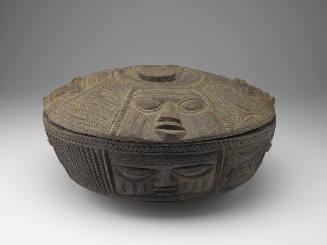
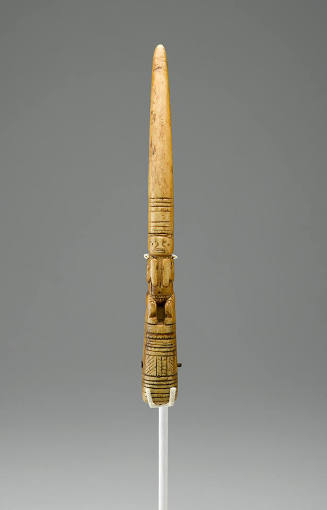
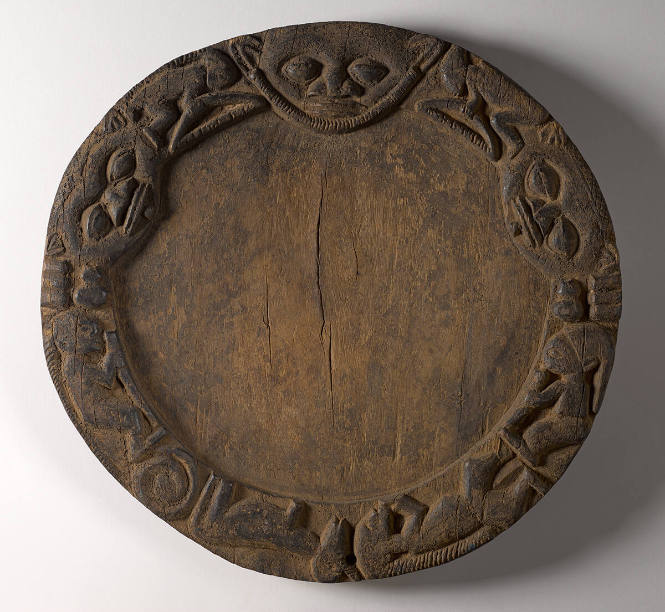
On viewIn divination, the babaláwo begins by striking the tip of the tapper against a divination tray's surface while reciting phrases that call the òriṣà's attention. He/She then spreads a layer of powder or sand over the tray, topped by a face that represents Èṣù, the òriṣà responsible for carrying messages between diviners and spirits.
Divination trays (ọpọ́n) are the central instrument used by the babaláwo and are always circular or occasionally rectangular, with a central depression as the diviner’s work-space encompassed by a raised border of relief carvings. The visual center of the divination tray is intentionally a tabula rasa wherein new imagery specific to an individual is constantly inscribed. The etymology of the term ọpọ́n means “to flatter” and the artistry of its embellishments is meant to praise the momentous work of diviners as they seek to disclose the forces active in a situation. The large frontal face—typical of all such trays—is Èṣù/Ẹlẹ́gbà, the divine mediator and messenger god who facilitates communication between the human and spiritual worlds.ProvenanceCreated in Nigeria, late 19th century. Roger de la Burde (1932-1992) Powhatan County, VA; to his daughter, Corinna M. Pugh [1]; [consigned to Charles Jones African Art, Wilmington, NC, 2007], Rhonda Morgan Wilkerson, Morrisville, NC, 2007; given to NCMA, 2024.
[1] After Roger de la Burde died in 1992, his estate was passed on to his three daughters. In 1994, his estate worked with Motley’s Auctions to sell some of de la Burde’s African art pieces. According to Charles Jones, owner of Charles Jones African Art, other pieces from de la Burde’s African art collection were put in storage. In 2007, he was contacted by Corinna M. Pugh, de la Burde’s daughter, who was looking to sell the African artworks in storage. Shortly after, Jones contacted Rhonda Morgan Wilkerson to buy pieces from the de la Burde collection.
Exhibition HistoryRaleigh, NC, North Carolina Museum of Art, "The People's Collection, Reimagined," October 7, 2022–present. Object Rights Statement
The North Carolina Museum of Art (NCMA) makes images of its collection available online to support research and scholarship and to inform and educate the public. Certain works of art, as well as the photographs of those works of art, may be protected by copyright, trademark, or related interests not owned by the NCMA. The responsibility for ascertaining whether any such rights exist and for obtaining all other necessary permissions remains with the applicant. To request images and/or permissions from the NCMA, please complete our online request form.