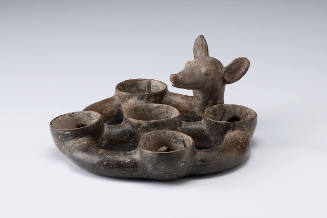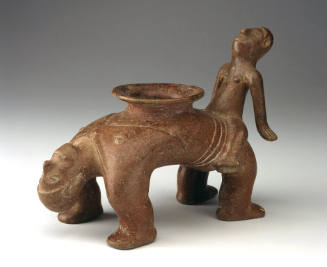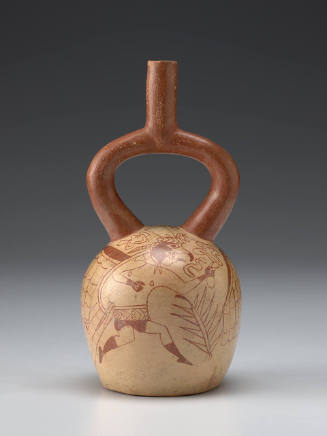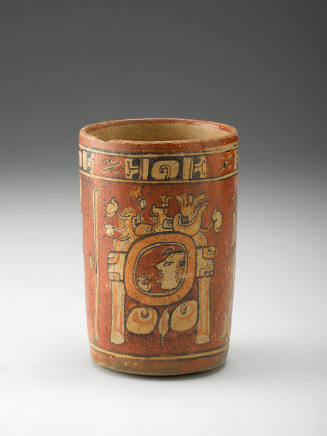
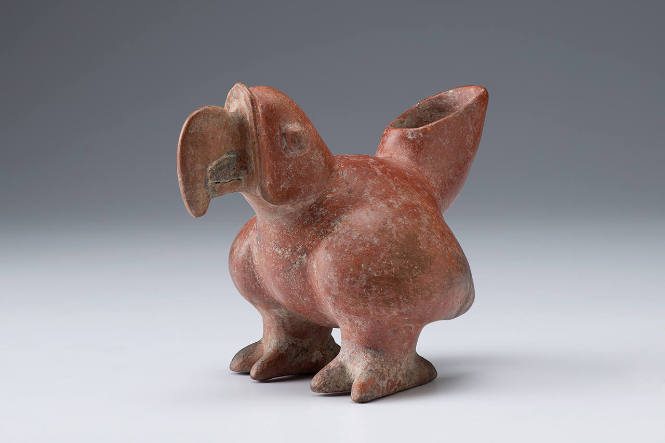
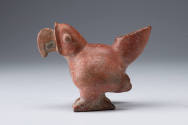
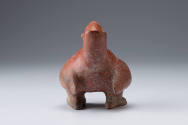

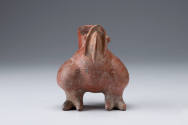
Parrot Effigy Vessel
Artist
Unknown
Datecirca 200 BCE–300 CE
MediumCeramic with red slip paint
Dimensionsheight, width, and depth: 7 1/4 × 6 1/4 × 9 3/4 in. (18.4 × 15.9 × 24.8 cm)
ClassificationsCeramics
Credit LineGift in memory of Dr. Franz Ebstein and Paul R. Villard
Object number90.6
On View
On viewThe animal most frequently depicted in Colima art is the hairless dog, today known as the Chihuahua but called xoloitzcuintli (pronounced show-low-eats-kweent-lee) by the Aztecs of the fifteenth century. In addition to raising dogs as a food source, many peoples of highland Mexico believed that a dog accompanied a person's soul on the journey into the underworld. Discovery of dog images in tombs suggests they were intended as companions for the deceased.
This vessel is modeled in the shape of a parrot, whose tail is fashioned as the vessel's spout. Similar to the dog, the parrot may have had symbolic associations.
Published ReferencesNorth Carolina Museum of Art Preview (Winter 1991-92), illus. (b-w) 33, frontispiece for the Annual Report (as new acquisition).
L. E. [Lisa Eveleigh], "Private Collectors Share Their Art," North Carolina Museum of Art Preview (Autumn 1992), illus. (b-w) 11.
Preview: The Magazine of the North Carolina Museum of Art (May/June 2002), illus. (color) inside back cover.
Exhibition HistoryRaleigh, NC, North Carolina Museum of Art, "The People's Collection, Reimagined," October 7, 2022–present. Object Rights Statement
The North Carolina Museum of Art (NCMA) makes images of its collection available online to support research and scholarship and to inform and educate the public. Certain works of art, as well as the photographs of those works of art, may be protected by copyright, trademark, or related interests not owned by the NCMA. The responsibility for ascertaining whether any such rights exist and for obtaining all other necessary permissions remains with the applicant. To request images and/or permissions from the NCMA, please complete our online request form.