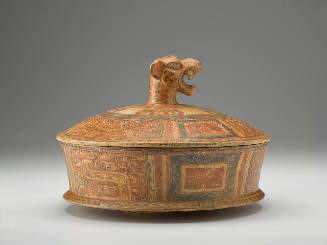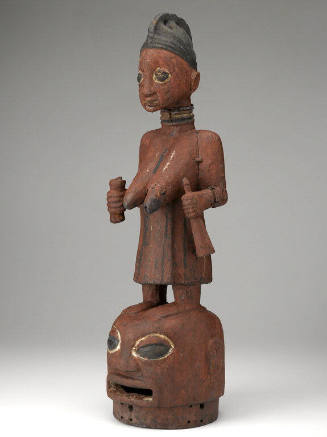

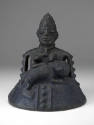
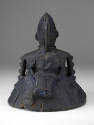
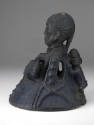
Lid of a Ceremonial Vessel (awa ota Eyinle)
Artist
Artist Unknown
Datelate 19th–early 20th century
MediumTerracotta and indigo pigment
Dimensions14 x 12 1/4 x 12 1/4 in. (35.6 x 31.1 x 31.1 cm)
ClassificationsSculpture
Credit LineGift of Lee and Dona Bronson
Object numberG.77.7.4
On View
Not on viewThe lid is decorated with bosses, small projections that refer to the sacred stones within. The four-sided, openwork summit is called an ade (crown), referring to the importance of the head as the seat of creativity, royalty, individuality, and ase—divine energy and the power to ‘make things happen.’ Placed on a raised earthen platform, the vessel creates a womb that protects and nurtures the ase of Eyinle that in turn invigorates the devotee.Published ReferencesRebecca Martin Nagy, entry for Lid of a Ceremonial Vessel, in North Carolina Museum of Art: Handbook of the Collections, Rebecca Martin Nagy, ed. (Raleigh: North Carolina Museum of Art, 1998), 54, illus. (color).
Seeing Women: Celebrating Women's History through Art, Newspapers in Education (supplement to the Raleigh News & Observer, n.d.), 4-5, illus. (b-w) 4.
Rebecca Martin Nagy, entry for Lid of a Ceremonial Vessel, in North Carolina Museum of Art: Handbook of the Collections, rev. ed. (Raleigh: North Carolina Museum of Art, 2010), 114, illus. (color) 115.
Exhibition HistoryRaleigh, NC, North Carolina Museum of Art, “Recent Acquisitions,” December 14, 1978-January 28, 1979.
Raleigh, NC, North Carolina Museum of Art, Mary Duke Biddle Gallery, “Yoruba Art: A Living Tradition,” October 23, 1993-June 12, 1994.
Raleigh, NC, North Carolina Museum of Art, “Sacred Motherhood: Mother-and-Child Representations from the Permanent Collection,” May 4–December 7, 2014. Object Rights Statement
The North Carolina Museum of Art (NCMA) makes images of its collection available online to support research and scholarship and to inform and educate the public. Certain works of art, as well as the photographs of those works of art, may be protected by copyright, trademark, or related interests not owned by the NCMA. The responsibility for ascertaining whether any such rights exist and for obtaining all other necessary permissions remains with the applicant. To request images and/or permissions from the NCMA, please complete our online request form.